

Government shutdown begins: Live updates as shutdown takes effect

WASHINGTON - The U.S. is under its first federal government shutdown in nearly seven years after Senate Democrats rejected a Republican-backed bill to keep funding the government.
Government funding legislation was not passed by Congress on Tuesday night, which means many government offices across the nation will be temporarily shuttered, and nonexempt federal employees will be furloughed, adding to the strain on workers and the nation’s economy.
Here's the latest on the effort to avoid a government shutdown:
U.S. government shuts down
12 a.m. ET: The U.S. government has officially shutdown for the first time in nearly seven years.
Senate adjourned until Wednesday
8:30 p.m. ET: The Senate has adjourned for the night without approving a funding bill to keep the government open after midnight tonight.
This means a shutdown is certain at 12:01 a.m. Wednesday.

Latest updates from Congress as shutdown looms
The U.S. is likely to face its first federal government shutdown in nearly seven years after Senate Democrats rejected a Republican-backed bill to keep funding the government. This means a shutdown will almost certainly take place at 12:01 a.m. Wednesday. Reporting from Capitol Hill tonight, Fox News Radio's Ryan Schmelz joins LiveNOW's J Russel with the latest updates.
Democratic senators voted down House-passed legislation to keep the government running for the next seven weeks and Republicans said they would not negotiate on the bill, leaving Congress at an uncertain impasse.
Senators will return to work Wednesday morning. Senate Majority Leader John Thune says he’s hoping that enough Democrats will change their votes to reopen soon.
The House is not in session this week.
OMB issues memo directing agencies to implement plans for shutdown
8:24 p.m. ET: The Office of Management and Budget has sent a memo to the heads of its agencies to prepare for a shutdown.
OMB Director Russell Vought wrote in a copy of the memo posted on social media platform X that, "affected agencies should now execute their plans for an orderly shutdown."
The memo also noted that the length of the shutdown would be "difficult to predict."
Democrats vote down GOP bill to keep the government open
7:25 p.m. ET The 55-45 vote on the bill to extend federal funding for seven weeks has fallen short of the 60 needed to end a filibuster and pass the legislation.

Senators react after votes to fund government fail
The U.S. government will shutdown at midnight, according to the White House. It will be the first government shutdown in almost seven years. Republican and Democratic Senators gave remarks after the Senate rejected bills to fund the government.
The failed vote comes as Democrats are making good on their threat to close the government if Trump and Republicans won’t accede to their health care demands. Senate Democratic Leader Chuck Schumer, D-N.Y., said Republicans are trying to "bully" Democrats by refusing to negotiate on an extension of health care benefits and other priorities.
Instead of negotiating, Democrats and Republicans have angrily blamed each other and refused to budge from their positions.
Senate roll call is underway on government funding bill
6:45 p.m. ET The Senate is voting — one more time — on a temporary bill to fund the government and avert a federal shutdown.
But the outcome may be no different than the last time.
Democrats are rejecting the Republican bill that would fund operations into mid-November because it fails to include funds they are demanding to save health care programs. A Democratic-led bill that includes funding was again defeated.
National Park Service doesn’t have shutdown plan
5:50 p.m. ET With a potential federal government shutdown just hours away, the National Park Service has not said whether it will close its more than 400 sites across the U.S. to visitors.
Park officials say contingency plans are still being updated and would be posted to the service’s website.
Many national parks including Yellowstone and Yosemite stayed open during a 35-day shutdown during Trump’s first term. Limited staffing led to vandalism, gates being pried open and other problems, including an off-roader mowing down one of the namesake trees at Joshua Tree National Park in California.
A group of former national park superintendents last week called for parks to close in case of a government shutdown to protect park resources and visitor safety. States including Utah, Colorado and New York donated money to keep some national park sites open during past shutdowns.
Government website blames Democrats
4:20 p.m. ET: A large banner on the website for the U.S. Department of Housing and Urban Development displays a partisan message blaming Democrats for the potential shurtdown.
"The Radical Left are going to shut down the government and inflict massive pain on the American people unless they get their $1.5 trillion wish list of demands," reads the pop-up note, which all users must close in order to use the site. "The Trump administration wants to keep the government open for the American people."
GOP senator warns White House will make shutdown ‘very painful’ for Democrats
1:40 p.m. ET: "I don’t think they have thought through what I believe the OMB director is going to do while government is shut down, I think they’re going to make it very painful," said Sen. John Kennedy, a Louisiana Republican.
Kennedy said he had "no inside information" about how Russ Vought, the White House’s director for the Office of Management, planned to respond to a potential government shutdown.
Trump on a government shutdown: ‘Nothing is inevitable’ but ‘it’s probably likely’
1:20 p.m. ET: According to the Associated Press, President Donald Trump continued to attempt to blame congressional Democrats, despite Republicans controlling both chambers of Congress and the White House.
"They are shutting it down, we’re not shutting it down," he said.
Trump also threatened political retribution unless a funding deal is reached.
"We can do things during the shutdown that are irreversible that are bad for them, and then irreversible by them," he said, suggesting reductions to federal programs Democrats support.
The AP noted that Trump didn’t offer details but said actions during a shutdown could include "cutting vast numbers of people out, cutting things that they like, cutting programs that they like."
Democrats warn that Trump has already let go thousands of federal workers
12:45 p.m. ET: Asked about the Democrats’ message to federal workers getting furloughs and layoffs in a shutdown, one said the Trump administration has already fired tens of thousands of employees — before any shutdown.
"They’re letting people go left and right," said Rep. Rosa DeLauro, the top Democrat on the House Appropriations Committee, because "it’s working at dismantling the federal government."
"We do not want to shut the government down," she said. "The Republicans are in charge here. They need to come to the table."

Democratic leaders speak on shutdown, healthcare costs
Senate minority leader Chuck Schumer (D-NY) discussed the looming government shutdown and healthcare costs with other Democratic Senate leaders on Capitol Hill.
House Democrats fill the chamber to show support for their funding bill
12:30 p.m. ET: House Democrats filled the House chamber as they tried to show they were ready to take up government funding — as long as it is on their terms.
The House was holding a pro forma session — a session where the House chamber is quickly opened and closed without any legislative business — but Democrats, who are in Washington to show support for their government shutdown fight, filled their side of the chamber.
CBO: 750,000 federal employees could be furloughed daily in shutdown
12:20 p.m. ET: The Congressional Budget Office estimates that roughly 750,000 federal employees could be furloughed each day of a shutdown, with the total daily cost of their compensation at roughly $400 million, according to an analysis of federal agencies’ latest contingency plans and the Office of Personnel Management.
The estimate released Tuesday comes in response to Sen. Joni Ernst’s request for an analysis of the impact of what she calls a "Schumer Shutdown" which includes a series of questions about how much damage to the economy would be caused and the expected daily costs to the federal government in lost efficiencies.
"The effects of a shutdown depend on its duration and on an Administration’s decisions about how to proceed," the CBO says in its Tuesday analysis, largely using work CBO published in 2019 after the five-week partial shutdown from December 22, 2018, until January 25, 2019.
The government will shut down at 12:01 a.m. Wednesday if the Senate does not pass a House measure that would extend federal funding for seven weeks while lawmakers finish their work on annual spending bills.
EPA memo says agency would retain more than 10% staffing in a government shutdown
12:15 p.m. ET: The Environmental Protection Agency says a contingency plan for a possible government shutdown would leave more than 10% of its staff in place to handle "significant agency activities" that are required by law or necessary to protect life and property.
Activities that would continue include protection of EPA land, buildings, equipment and ongoing research, as well as law enforcement and criminal investigations and emergency and disaster assistance, according to a contingency plan obtained by The Associated Press.
Response work on certain Superfund clean-up sites also would continue, especially in cases where a failure to maintain operations would pose an imminent threat to human life, the memo says.
More than 1,700 employees would be required to go to work if a shutdown begins on Wednesday, the memo said. The agency had about 15,000 employees when Trump began his second term in January but has laid off hundreds of employees and offered voluntary retirement or deferred resignations to thousands more as part of a broader effort by Trump and billionaire Elon Musk to downsize the federal workforce.
Trump’s proposed budget for EPA says 12,856 employees are expected in the budget year that starts Wednesday.
Democrats gathering in protest at the House
11:58 a.m. ET: Democrats are gathering at the House chamber in protest as they push their demands to save health care funds as part of any deal to avert a federal government shutdown.
Senate leaders debate shutdown live on chamber floor
11:30 a.m. ET: The Associated Press reported that Senate Majority Leader John Thune and Democratic Leader Chuck Schumer clashed publicly Tuesday as tensions over a possible government shutdown carried over to the Senate floor.
After Thune delivered his opening remarks, Schumer followed as Thune watched. Schumer accused Republicans of "trying to bully us," and said, "Thune did not come once to me and say is this bill acceptable."
"That is not how you negotiate," Schumer added, directly addressing Thune.
Thune pushed back during Schumer’s remarks, interjecting at one point: "The way we’ve done it, it’s a different business model than the one he used."
Senate in session as legislators discuss possible government shutdown
11 a.m. ET: Lawmakers are on the Senate floor discussing the potential for a government shutdown with the deadline looming.
Jeffries says spending bill must address health care concerns
10:45 a.m. ET: Democratic leader Hakeem Jeffries said he would continue to try and have conversations Tuesday with the Trump administration and Republican counterparts on avoiding a government shutdown at the end of the day.
"But what we’re not going to do is be part of essentially a my way or the highway approach," Jeffries said on CNBC as congressional leaders hit the airwaves in advance of a potential shutdown.
Democrats are demanding that Republicans include in the spending bill an extension of enhanced tax credits that are set to expire at the end of the year for those who purchase coverage through the marketplaces established by the Affordable Care Act.
Republicans have said that’s a policy issue that can be dealt with in later months, but Jeffries said Democrats weren’t going to support a bill that "continues to gut the health care of the American people."

President Trump on government shutdown & more
President Trump answered questions for the media before departing for Virginia. The president talked about layoffs amid a possible government shutdown, Hamas and more.
House Speaker Mike Johnson voices skepticism about avoiding a government shutdown
10:15 a.m. ET: House Speaker Mike Johnson said whether the government shuts down after midnight is up to two people — Democratic leaders Chuck Schumer in the Senate and Hakeem Jeffries in the House.
Johnson made his comments in a CNBC interview as congressional leaders hit the air Tuesday morning to shape the messaging battles going into a likely shutdown.
The Associated Press noted that Johnson said there are no partisan policy riders in the short-term funding patch that has failed to advance in the Senate after passing the House. He noted that Democrats routinely supported such resolutions during Joe Biden’s presidency.
"They don’t want to do it because they want to fight Trump," Johnson said. "A lot of good people are going to be hurt because of this."
Republicans create a measure to fund government through November
9 a.m. ET: The Associated Press reported that Republicans have crafted a short-term measure to fund the government through Nov. 21, but Democrats have insisted the measure address their concerns on health care.
Democrats are pushing to reverse the Medicaid cuts in President Donald Trump’s massive tax bill passed this summer and extend tax credits that make health insurance premiums more affordable for millions of people who purchase through the marketplaces established by the Affordable Care Act.
According to the AP, Republicans, who hold a 53-47 majority in the Senate, would likely need at least eight votes from Democrats to end a filibuster and pass the bill with 60 votes, since Republican Sen. Rand Paul of Kentucky is expected to vote against it.
Senate must pass funding measure to avoid shutdown
7:30 a.m. ET: The federal government will shut down at 12:01 a.m. Wednesday if the Senate does not pass a House measure that would extend federal funding for seven weeks while lawmakers finish their work on annual spending bills.
According to the Associated Press, Senate Democrats say they won’t vote for it unless Republicans include an extension of expiring health care benefits, among other demands, while President Donald Trump and Republicans are refusing to negotiate, arguing that it's a stripped-down, "clean" bill that should be noncontroversial.
What's leading to a possible government shutdown?
The backstory:
Republicans have crafted a short-term measure to fund the government through Nov. 21, but Democrats have insisted that the measure address their concerns on health care. They want to reverse the Medicaid cuts in President Donald Trump’s mega-bill passed this summer as well as extend tax credits that make health insurance premiums more affordable for millions who purchase through the marketplaces established by the Affordable Care Act. Republicans say that’s all a non-starter.
RELATED: Government shutdown looms: Mass layoffs threaten federal workers
Neither side is showing any signs of budging, with the House not even expected to be in session before a shutdown has begun.

JD Vance fiery comments on government shutdown
Vice President JD Vance gave remarks outside the White House on the potential for a government shutdown, expressing his disagreement with how Chuck Schumer and other democrats are handling the issue.
What is a government shutdown?
Dig deeper:
A government shutdown happens when Congress doesn’t pass legislation either temporarily or more permanently funding the government, and such a measure isn’t signed by the president.
RELATED: Dems to propose alternative to GOP stopgap bill as government shutdown looms

Potential government shutdown slated for Oct. 1st
The U.S. federal government faces a potential shutdown on Oct. 1, 2025, as Congress remains at an impasse over funding. Lawmakers continue to negotiate amid disputes over spending priorities and health care programs. Cami Mondeaux, Deseret Reporter, joins LiveNOW from FOX’s Christina Evans to discuss the latest developments.
Which government agencies would be affected by a shutdown?
Why you should care:
Each federal agency determines its own plan for how to handle a shutdown, but basically any government operations deemed non-essential stop happening, and hundreds of thousands of federal employees see their work disrupted.
Sometimes workers are furloughed, meaning that they keep their jobs but temporarily don’t work until the government reopens. Other federal workers may stay on the job but without pay, with the expectation that they would be paid back in full once the government reopens.
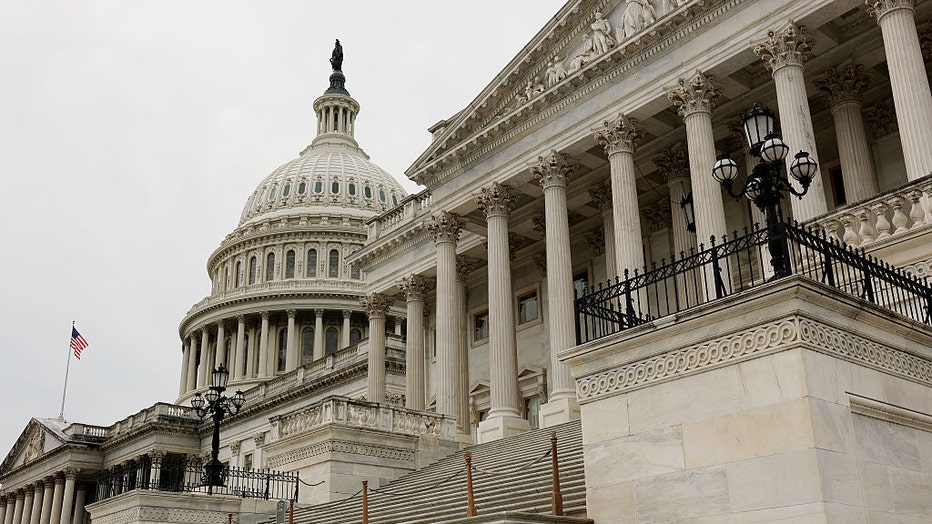
A view of the U.S. Capitol on September 29, 2025, in Washington, DC. (Photo by Anna Moneymaker/Getty Images)
The basic rules for who works and who doesn’t date back to the early 1980s and haven’t been significantly modified since. Under a precedent-setting memorandum penned by then-President Ronald Reagan budget chief David Stockman, federal workers are exempted from furloughs if their jobs are national security-related or if they perform essential activities that "protect life and property."
Essential government agencies like the FBI, the Border Patrol and the Coast Guard remain open. Transportation Security Administration officers would continue to staff airport checkpoints. The U.S. Postal Service also won’t be affected because it’s an independent agency.
But national parks and monuments would close, and while troops would stay at their posts, many civilian employees in agencies like the Department of Defense would be sent home. Court systems would be affected, too, with civil proceedings paused, while criminal prosecutions continue.
Automated tax collection would stay on track, but the Internal Revenue Service would stop auditing tax returns.
Will a government shutdown affect Social Security checks?
No. Recipients of both Social Security and Medicare would continue to receive their benefits, which are part of mandatory spending that’s not subject to annual appropriations measures. Doctors and hospitals would also continue to get their Medicare and Medicaid reimbursements.
But it’s possible that new applications wouldn’t be processed. During a government shutdown in 1996, thousands of Medicare applicants were turned away daily.
The Source: The Associated Press contributed to this report. The information in this story is drawn from reporting on the ongoing budget standoff in Congress, outlining positions from both Democratic and Republican leaders. This story was reported from Los Angeles.