

Celebrating 250 years: The U.S. Navy, founded on October 13, 1775
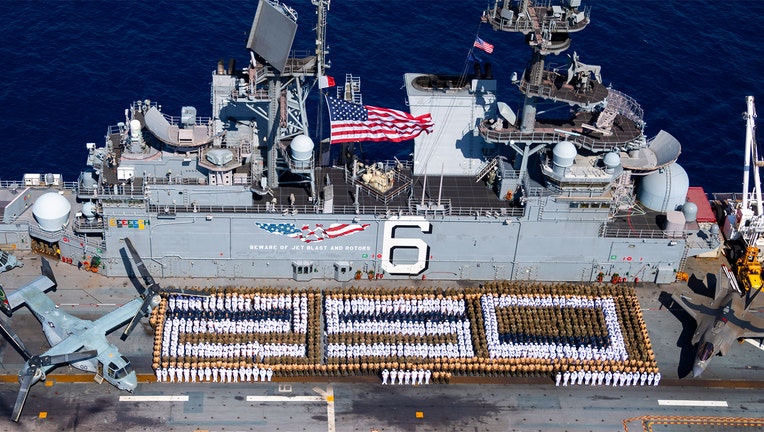
Sailors assigned to the forward-deployed amphibious assault ship USS America (LHA 6) and U.S. Marines with the 31st Marine Expeditionary Unit (MEU) stand in formation for a photo commemorating 250 years of naval service. (U.S. Navy photo illustration
WASHINGTON - The United States Navy is celebrating 250 years of service, sacrifice, and tradition, commemorating its founding on October 13, 1775.

Pres. Trump celebrates the Navy’s 250th anniversary
President Donald Trump joined sailors and military leaders in Norfolk, Virginia for a celebration of the Navy’s 250th anniversary.
U.S. Navy history
Timeline:
The American Revolution — 1775–1783
At the onset of the conflict, the importance of naval power was recognized. By 1776, the 13 colonies had 27 warships, greatly outnumbered by the Royal British Navy, which had about 270 warships. During the war, most American naval actions saw success disrupting British supply lines.
Aided by French allies at the Battle of the Virginia Capes in September 1781, the Navy was able to prevent the Royal Navy from reinforcing or evacuating the besieged British forces at Yorktown, Virginia, which was instrumental in securing independence for the Colonies.
The War of 1812
On 18 June 1812, the United States formally declared war on Great Britain due to that nation’s continued attempts to restrict trade on the high seas.
The U.S. Navy played a vital role in the conflict, with the USS Constitution earning the nickname "Old Ironsides" when cannonballs fired from the British frigate HMS Guerriere appeared to bounce off its incredibly thick hull.
The war ended in 1814 when British and American delegates signed the Treaty of Ghent.
The Civil War — 1961–1965
During the Civil War, the Union and Confederate navies fought for control over inland and coastal waterways. The U.S. Navy fought hard and was able blockade more than 3,500 miles of coastline, coordinating amphibious attacks, and bombarding coastal fortifications held by the Confederate armed forces ultimately ensuring victory for the Union.
The Spanish-American War — 1898
The Navy was asked during the Spanish-American War to gain control of the waters around the Philippine Islands and the Caribbean Sea.
The four-month conflict is seen as the transformation of the United States from a developing nation into a global power. At the end of the war, the United States had acquired the Philippines, Guam, and Puerto Rico and the war was also the first successful test of the new armored navy.
World War I — 1917-1918
The Navy’s primary role was to combat German U-boats in the Atlantic Ocean and Mediterranean Sea. The most significant contribution was escorting and transporting two million U.S. soldiers to France.
World War II - 1939–1945
World War II saw the Navy grow into a dominant global force, playing a significant role in the war.
Battle of Midway: 4–7 June 1942
The Battle of Midway, which took place six months after the attack on Pearl Harbor, was a major naval battle in the Pacific. The Navy intercepted a Japanese invasion fleet heading for the island, achieving an overwhelming victory. The battle was a turning point of the war in the Pacific.
D-Day Normandy — June 6, 1944
During D-Day, codenamed Operation Neptune, the U.S. Navy was part of an invasion force that included 7,000 ships and landing craft manned by over 195,000 naval personnel from eight allied countries. The fleet transported almost 133,000 troops from the United States, the British Commonwealth, and their allies, onto the beaches of Normandy, France, for the largest amphibious assault in history.
Battle of Samar — October 25, 1944
The conflict was a campaign to liberate the Philippines from Japanese occupation. In the early morning of October 25, 1944, four Japanese battleships, eight cruisers, and eleven destroyers surprised the Allies.
Outnumbered and facing overwhelming firepower, the small American task force "Taffy 3" fought valiantly against a much larger Japanese fleet. Destroyer escorts, destroyers, and escort carriers went toe-to-toe with battleships and cruisers in one of the most heroic naval actions of World War II. The heroic defense by Taffy 3 brought havoc to the Japanese forces, causing confusion and leading to their withdrawal.
Korean War — June 25, 1950–July 27, 1953
During the Korean War, the U.S. Navy provided critical air support, transported supplies, and supported ground forces with its aircraft carriers and shore-based aviation. Navy ships also performed amphibious assaults, transported troops and supplies, and conducted underwater demolition missions. This conflict saw the Navy playing a key role in the war's outcome and paving the way for future operations in the Cold War.
Vietnam War — Nov. 1, 1955 – Apr. 30, 1975
During the Vietnam War, the U.S. Navy participated in a wide variety of roles providing artillery, aviation, logistics, medical, and other support. Offshore, Navy ships provided essential naval gunfire support to allied forces engaged in combat operations ashore. Aircraft carriers served as bases for naval aircraft operating over North Vietnam and Laos, including missions against North Vietnamese forces on the Ho Chi Minh Trail.
Cuban Missile Crisis — Oct.16, 1962 – Oct. 29, 1962
The fall of 1962 saw the world on edge as the Soviet Union began construction on ballistic missile launch sites in Cuba. President Kennedy ordered a naval blockade consisting of multiple aircraft carriers, escort ships, and destroyers, around Cuba. After 13 days, agreement was reached with Soviet leader Khrushchev for the removal of the weapons. The crisis demonstrated the critical importance of naval forces to national defense.
The Gulf War — Aug. 2, 1990 – Feb. 28, 1991
The Gulf War was an armed conflict between Iraq and a 42-country coalition led by the United States after Iraq invaded Kuwait on Aug. 2, 1990. The coalition's efforts against Iraq were carried out in two key phases: Operation Desert Shield and Operation Desert Storm.
Operation Desert Shield — August 1990 to January 1991
Coalition Forces, comprised of Kuwaiti, American, British, French, Saudi Arabian, and Egyptian troops, moved into the region to discourage Iraq from invading Saudi Arabia after the invasion of Kuwait.
Operation Desert Storm Jan. 17, 1991–Feb. 28, 1991
Operation Desert Storm was a significant military campaign led by the United States and its allies against Iraq. The U.S. Navy provided sea control and maritime superiority by launching Tomahawk cruise missiles from ships stationed in the Persian Gulf and Red Sea, as well as air power, mine countermeasures, and amphibious assault.
Operation Enduring Freedom
Following the Sept. 11, 2001 terrorist attacks, the United States began Operation Enduring Freedom on Oct.7, 2001 with American and British forces launching bombing strikes against Osama bin Laden’s al-Qaeda network and Taliban forces in Afghanistan.
The campaign at first saw the Taliban removed from power and al-Qaeda seriously crippled, but forces dealt with a Taliban insurgency, and corruption among Afghanistan's Army, National Police, and Border Police.
The U.S. Navy played a vital role in Operation Enduring Freedom, launching cruise missiles from hundreds of miles away into Afghanistan.
The hunt for Osama bin Laden
On May 2, 2011, U.S. Navy SEALs conducted Operation Neptune Spear and raided Osama bin Laden’s compound in Abbottabad, Pakistan, killing the al-Qaeda leader who was the mastermind of the September 11th terrorist attacks.
Operation Enduring Freedom officially ended on Dec. 28, 2014, but coalition forces remained in Afghanistan to train Afghan security forces. The United States military completed its withdrawal from Afghanistan on Aug. 30, 2021, marking the end of the 2001-2021 war.
The Navy’s core values

Future sailors from Navy Recruiting District (NRD) Michigan take the Oath of Enlistment during a joint service enlistment ceremony on Armed Forces Day at Indianapolis Motor Speedway, May 19, 2019) (U.S. Navy photo by Mass Communication Specialist 1st
Every member of the Naval Service – active, reserve, and civilian, must understand and live by the Navy’s Core Values — honor, courage, commitment.
The Navy says its core values are the foundation of trust and leadership on which the Navy's strength is based and how victory is achieved.
The Sailor's Creed
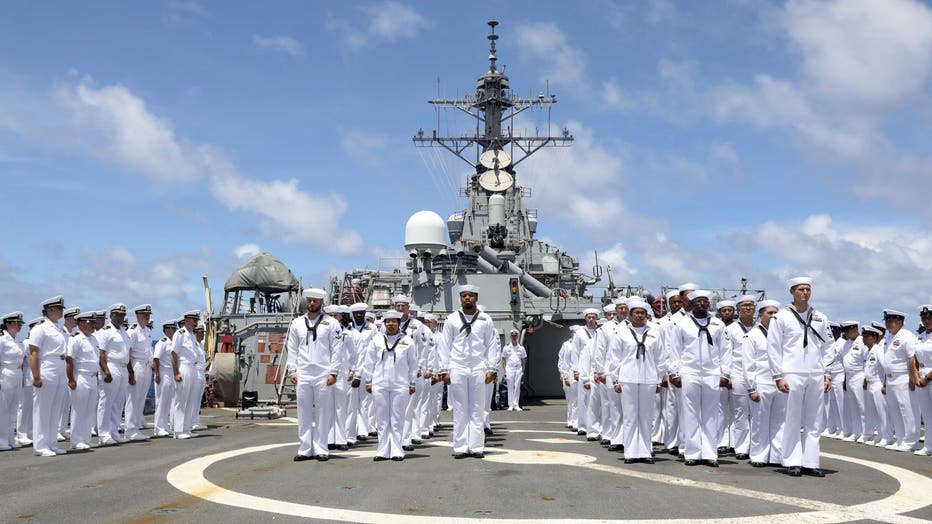
Sailors assigned to Arleigh Burke-class guided-missile destroyer USS Barry (DDG 52) stand in formation. (U.S. Navy photo by Mass Communication Specialist 1st Class Greg Johnson)
The Sailor’s Creed, which focuses on self-respect, respect for others, and core values of honor, courage, and commitment, governs virtually all aspects of a sailor’s existence while in the Navy. It is a staple of Navy culture, often recited like a pledge of allegiance, reminding all service members of whom they are, and why they serve.
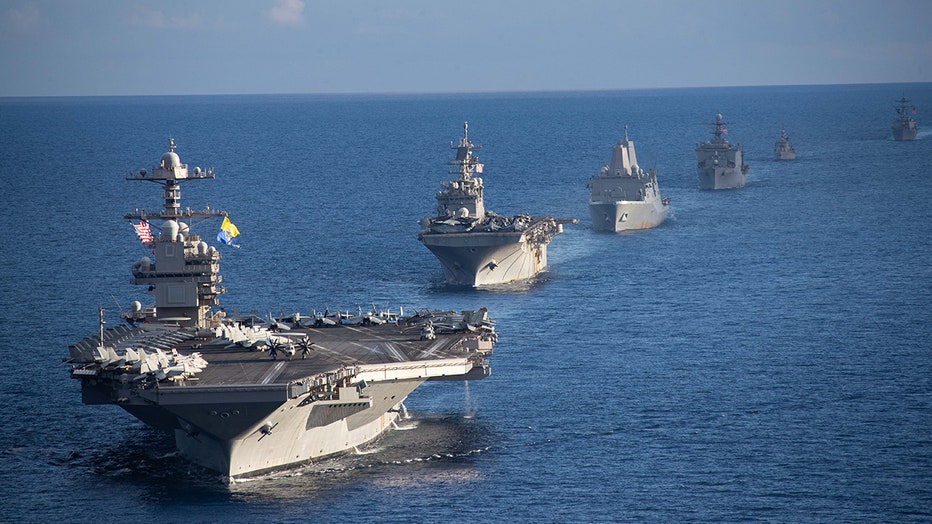
Ships from the Gerald R. Ford Carrier Strike Group sail in formation in the Mediterranean Sea, Dec. 31, 2023. (U.S. Navy photo by Mass Communication Specialist 3rd Class Maxwell Orlosky)
Today’s United States Navy
U.S. Navy Fleet
By the numbers:
The U.S. Navy has a fleet of approximately 465 ships consisting of carriers, destroyers, and submarines, in both active and reserve status. The Navy's fleet total is fluid as there are new ships being built and older ones in the process of being retired.
U.S. Navy Personnel
By the numbers:
As of August 31, 2025, the U.S. Navy had a total of 398,581 Sailors — 340,268 active duty and 58,313 reservists.
The Source: Information for this article was sourced from the U.S. Navy, the Naval History and Heritage Command, and The Defense Manpower Data Center (DMDC). This story was reported from Orlando.