Taliban bans women from universities until further notice
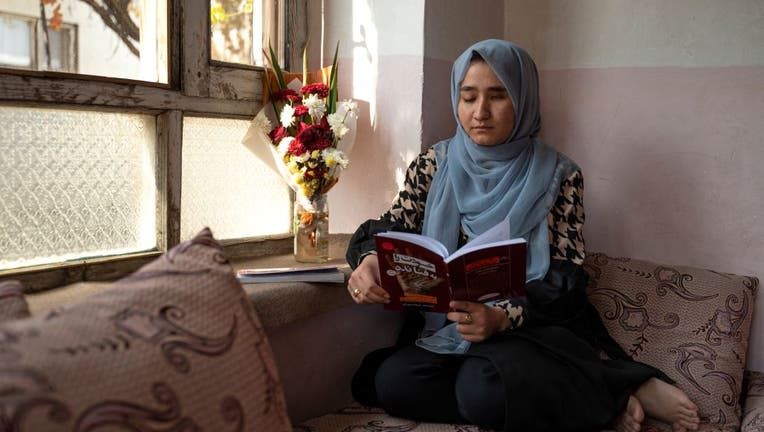
Afghan Hazara female student Fatima Amiri reads a book at her home in Dasht-e-Barchi in Kabul on Novembr 7, 2022. (Photo by WAKIL KOHSAR/AFP via Getty Images)
KABUL, Afghanistan (AP) - Women are banned from private and public universities in Afghanistan with immediate effect and until further notice, a Taliban government spokesman said Tuesday, the latest edict cracking down on their rights and freedoms.
The decision was announced after a meeting of the Taliban government.
Despite initially promising a more moderate rule and women's and minority rights, the Taliban have widely implemented their harsh interpretation of Islamic law, or Sharia.
RELATED: Taliban carry out 1st public execution since Afghan takeover
They have banned girls from middle school and high school, restricted women from most employment and ordered them to wear head-to-toe clothing in public. Women are also banned from parks and gyms.

August marks the one-year anniversary of American withdrawal from Afghanistan, and since then, the country has spiraled, as many feared, and it is now in a deep humanitarian crisis. As a result of the turmoil, thousands of Afghans have fled from the country, and many of them re-settled in Arizona. One of the refugees who re-settled in Arizona is Fahima Sultani. "I thought the whole world collapsed on my head, when I got to know that the Taliban took control in Afghanistan," said Sultani, who is now a student at Arizona State University. Sultani was born in 2001. Growing up in Afghanistan, she never lived under the Taliban regime, but always feared the stories her parents told her. Those fears turned to reality as the Taliban took control, and word spread that American and NATO troops were leaving the country. Sultani said she knew she had to get out, and fast. "I was thinking if they kill me, let them do this because if I stay in Afghanistan, I will be kind of a dead body because I cannot speak," said Sultani. "Millions of girls right now, they don’t have the right to speak. They don’t have the right to live freely, to make decisions for themselves. So I thought that I will make it, or otherwise if they kill me, let them do this." Sultani left her family behind to start the dangerous journey to America. Like hundreds of others, she spent days trying to get into Kabul's airport. "The third day that we were trying to get into the airport, an explosion happened," Sultani recounted. "A lot of fighting’s happened. Gunfighting and gunshots happened, and a lot of people got killed from our group. We were seven buses, and several girls just gave up. They were so frightened and afraid." Eventually, Sultani made it onto a plane to Washington D.C.. From there, she went on to a military base in Wisconsin, where she stayed for three months. That was when ASU found her. They welcomed Sultani, along with 63 other students from Afghanistan. "It's like heaven for me," said Sultani. "I have a lot of opportunities as a student, as a girl, as a human. I have a lot of opportunities. I can be myself, I can dress the way I want to, I can go wherever I want, anytime, without a man or a male surrounding me." Now, Sultani is studying business administration and entrepreneurship. She also helps international students on campus, but her biggest dream is to create her own non-profit, helping women and children back in Afghanistan. "I can work, I can do my studies, I can even dream bigger than before," said Sultani. "I can work on my potential to be stronger than ever."
A letter shared by the spokesman for the Ministry of Higher Education, Ziaullah Hashmi, tells private and public universities to implement the ban as soon as possible and to inform the ministry once the ban is in place.
Hashmi also tweeted the letter from his account and confirmed its contents in a message to The Associated Press.
The university ban comes weeks after Afghan girls took their high school graduation exams, even though they have been banned from classrooms since the Taliban took over the country last year.