

State Department issues updated Mexico travel advisory: What to know

Mexico rejects U.S. military plan against cartels
U.S. officials said Trump's administration can use the military to go after Latin American drug gangs that have been designated as global terrorist organizations and has quietly ordered the Pentagon to prepare options, according to a report from Reuters. National security analyst Hal Kempfer breaks this all down with LiveNOW's Austin Westfall.
Travelers heading to Mexico are urged to "exercise increased caution" after the U.S. State Department updated its travel advisory for our North American neighbor.
The Level 2 advisory was issued to warn travelers about an increased risk of terrorism, crime and kidnapping or hostage-taking, according to the State Department’s website.
Mexico travel risks
What they're saying:
"Many violent crimes take place in Mexico," the State Department says. "They include homicide, kidnapping, carjacking, and robbery. There is a risk of terrorist violence, including terrorist attacks and other activity in Mexico."
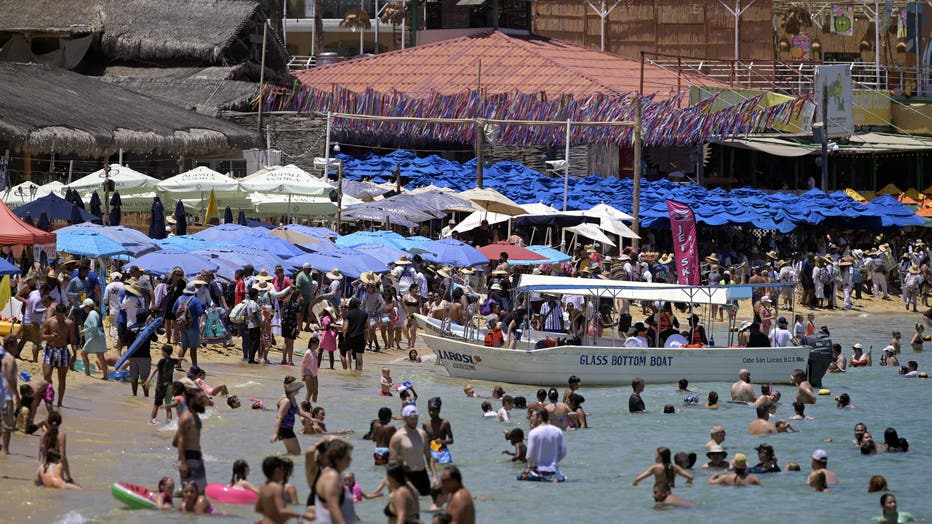
Tourists enjoy the beach at a resort in Los Cabos, Baja California, Mexico on July 15, 2025. (Photo by ALFREDO ESTRELLA/AFP via Getty Images)
"The U.S. government has limited ability to help in many parts of Mexico. U.S. government employees are not allowed to travel to certain high-risk areas. Due to security risks, U.S. citizens should follow the same restrictions as U.S. government employees while traveling."
The State Department warns that countries with a terrorism risk indicator could be subject to terrorist attacks with little to no warning at the following places:
- Tourist locations
- Transportation centers like airports and train stations
- Markets and shopping malls
- Local government facilities
- Hotels, clubs, and restaurants
- Places of worship and educational institutions
- Parks
- Major sporting and cultural events
Mexico Level 2 travel advisory
Local perspective:
Mexico’s travel advisory no longer includes a level for the country as a whole. Instead, each state receives its own advisory. Most states in Mexico are currently under a Level 2, or "exercised increased caution," travel advisory, the State Department says. However, eight states in Mexico are under Level 3 advisories, urging people to reconsider travel to the states of Baja California, Chiapas, Chihuahua, Coahuila, Guanajuato, Jalisco, Morelos and Sonora. Two states – Campeche and Yucatan – are under Level 1, or "exercise normal precautions" advisories.
RELATED: Mexico to extradite 26 top cartel leaders to US in Trump administration deal
The northern half of Mexico is generally a higher-threat area, "primarily due to organized criminal conflicts and competition for drug trafficking routes to the U.S.," the Overseas Security Advisory Council warns.
Timeline: The advisory was updated Aug. 12 to designate level 2 warnings and add "terrorism" to the risk indicator, according to the State Department.
Crime in Mexico
Dig deeper:
According to a report from the Overseas Security Advisory Council, Mexico "suffers from high rates of crime, exacerbated by its low rate of criminal convictions."
"Most crime in Mexico goes unreported or simply cannot be accurately captured due to large number of individuals who have ‘disappeared,’" OSAC warns.
"Although there is no evidence of criminals specifically targeting foreign or U.S. businesses and personnel, criminals will target victims based on the appearance of affluence, vulnerability, or lack of awareness," the report continues. "Armed robbery, kidnapping, car theft, credit card fraud, and various forms of residential/street crime are daily concerns. Criminals can easily resell jewelry (including expensive watches) and cellular phones in illegal markets. Although Mexico has strict gun-control laws, criminals often carry handguns, knives, and increasingly high-caliber weapons."
By the numbers:
According to preliminary data from the Executive Secretariat of the National Public Security, the national homicide rate in Mexico increased marginally from 23.29 homicides per 100,000 residents in 2023 to 23.35 in 2024. That’s compared to the U.S. national homicide rate of 6.8 per 100,000 residents, according to the U.S. Centers for Disease Control and Prevention.
Mexico travel safety tips
What you can do:
Before you travel to Mexico, the State Department urges Americans to review its International Travel Checklist, with steps on how to join the Smart Traveler Enrollment Program and information on purchasing travel insurance.
"If you encounter a road checkpoint, you should comply," the State Department says. "Fleeing or ignoring instructions can lead to you being hurt or killed."
READ MORE: Americans planning Mexico vacations face new safety concerns as US raises travel advisory
OSAC also urges travelers in Mexico to "be careful of cash transactions on the street."
"A hurried transaction for merchandise often leaves the customer with shoddy or counterfeit goods, out-of-circulation valueless currency, or incorrect change," OSAC says. "Some vendors will accept U.S. dollars, but at their own exchange rate."
"The best ways to reduce the risk is to practice good personal security habits, especially maintaining a high-level of situational awareness and promptly departing from potentially dangerous situations."
The Source: This report includes information from the U.S. State Department, the Overseas Security Advisory Council, the U.S. Centers for Disease Control and Prevention and the Executive Secretariat of the National Public Security.