

Hurricane Katrina fueled major reforms at FEMA. Now, its future is uncertain

Life during – and after – Hurricane Katrina
In 2005, Hurricane Katrina swamped the Gulf Coast, flooding vulnerable New Orleans and driving millions from their homes. Reporters and residents alike were stranded in the swamped city – all looking for help and answers that, in some cases, never came.
In the wake of Hurricane Katrina, the Federal Emergency Management Agency became synonymous with chaos and dysfunction that crippled response efforts and left people stranded on rooftops for days.
Twenty years after the nation’s most destructive disaster killed roughly 1,400 people, experts have a much clearer picture of what went wrong, and whether FEMA was a scapegoat for massive failures at all levels of government.
Now, with the Trump administration slashing billions of dollars from disaster preparedness programs and potentially dismantling FEMA as a whole, emergency management workers fear drastic cuts will only shift the financial burden from paying the cost of disaster resources – to paying the cost of human suffering.
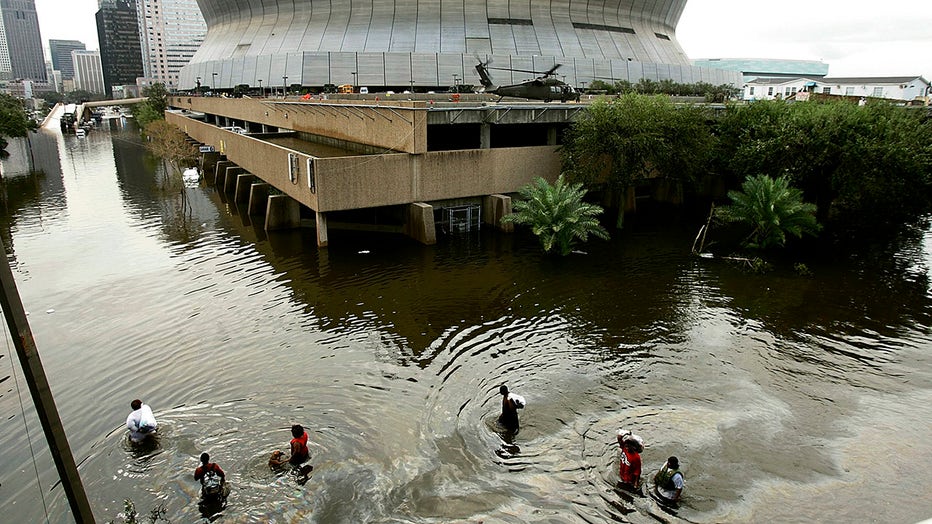
File: People walk through high water in front of the Superdome August 30, 2005 in New Orleans, Louisiana. (Photo by Mark Wilson/Getty Images)
"We always pay for these events. It's not a question of if we pay, it's how and how much," said Samantha Penta, an associate professor for the Emergency Management and Homeland Security Department at the University at Albany, State University of New York. "We can pay by paying for quality employees, investing in infrastructure, paying for disaster resources, or we can not do that, and pay in disruption and pay in loss of life."
RELATED: Hurricane Katrina: What happened on Aug. 29, 2005
Here’s a look back at FEMA’s role in Hurricane Katrina and how the storm fueled major reforms in disaster response.
How 9/11 shaped Katrina response
The backstory:
Before 9/11, FEMA’s director was a Cabinet-level position who had direct access to the president, Penta explained. Following the attacks, the country’s focus overwhelmingly shifted to counterterrorism and homeland security. This led to the creation of the Department of Homeland Security, and FEMA was absorbed into DHS.
"By the time we get to Katrina, we have several years under our belt now where we've really diminished as a country the importance or the attention to natural hazards and disasters caused by natural hazards, and all the systems that would be in place to deal with them," Penta said. "So that's one piece of it … If you want to talk about failures of a system, that was actually our first failure."
RELATED: Maps: New Orleans before & after Hurricane Katrina's floods
What went wrong
Big picture view:
The failure of the federal levee system designed to protect the below-sea-level city of New Orleans brought "dramatic and immediate hazards, chaos, and unexpected horrors" no one could have predicted, explained Rebecca Rouse, a professor at Tulane University’s School of Professional Advancement and a former FEMA employee.
RELATED: Viral video of eye-level ship highlights New Orleans' persisting flood risk
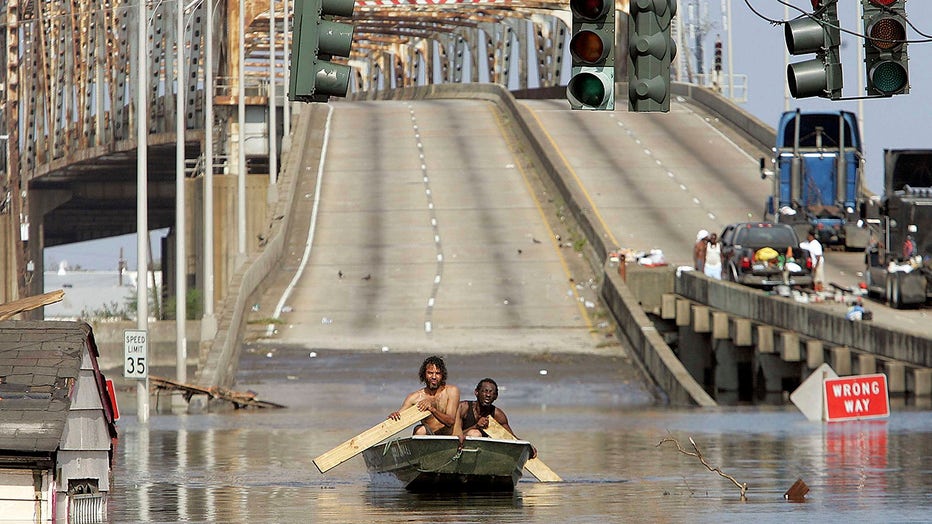
File: Two men paddle in high water after Hurricane Katrina devastated the area, August 31, 2005 in New Orleans, Louisiana. (Photo by Mario Tama/Getty Images)
From there, things got worse:
- There was a breakdown in communication, leading to tensions between local, state and federal agencies trying to respond to Hurricane Katrina. The timing of Louisiana’s request for federal aid is disputed, but Rouse recalled it was delayed and came after requests from Alabama and Mississippi.
- The mayor of New Orleans had waited until a day before Katrina hit to call for mandatory evacuations, leaving thousands of people with no way out.
- The hurricane struck down transmission towers, effectively wiping out communication capabilities like interoperable radios and shared frequencies agencies often rely on.
- Louisiana and FEMA officials had taken part in a "Hurricane Pam" disaster simulation in 2004 to identify weaknesses and develop a response plan for a catastrophic hurricane. Rouse said lessons from the simulation – like modifying evacuation plans and distributing resources – were ignored when Katrina hit a year later.
- FEMA’s leadership at the time, most notably the agency’s director Michael Brown, had no experience in disaster management, though Rouse points out that Katrina was an "event so catastrophic in nature, it would be overwhelming for any FEMA Administrator to oversee operations regardless of his or her background."
- The local police force was largely absent after the storm, leaving few officers to police a city filled with desperate people trying to survive.
"Eventually, FEMA was deployed to a monstrously cataclysmic event with expectations it could fix the outcome of many poor decisions including those made by others," Rouse said. "I am reluctant to characterize their efforts as failure."
FEMA is not a first responder
Dig deeper:
It’s important to note that FEMA is not a first responder, Penta explained. Disaster response starts at the local level, then the state government steps in when local resources are overwhelmed. The federal government can only become involved when states request help.
That doesn’t mean FEMA is "twiddling their thumbs": they can preemptively coordinate with states and have conversations that allow them to deploy quickly, "but they can’t do anything until they’re requested," Penta said.

Hurricane Katrina: Rebuilding after the storm
As LiveNOW continues our coverage of Hurricane Katrina, we wanted to share the story of Michael Hecht, the president and CEO of Greater New Orleans. In the days and months following the storm, he helped small business owners get back on their feet, and says rebuilding those small businesses still continues to this day.
"Many thought the president should have sent in resources and equipment, etc., even before being asked," Rouse said. "Even the president wanted to do this. But to do so would have been illegal, even if it were considered moral or ethical. Some might argue President Bush (and federal agencies) would have been forgiven for illegally entering Louisiana without being asked, but imagine the slippery slope that precedent might have created for subsequent presidents who may believe they have good cause to enter a sovereign state and conduct whatever operations they see fit to deliver."
RELATED: What is FEMA? The Federal Emergency Management Agency explained
What did FEMA learn from Katrina?
Katrina prompted so many changes to disaster response, there’s "enough material for a book," Rouse said. Here are some of the highlights:
Post Katrina Reform Act of 2006
This monumental legislation passed by Congress sought to improve emergency management as a mission – and as a profession. It offered new training, new systems, resources and expertise that benefited the emergency management field, Rouse said. It also required that future FEMA leaders have prior emergency management experience.
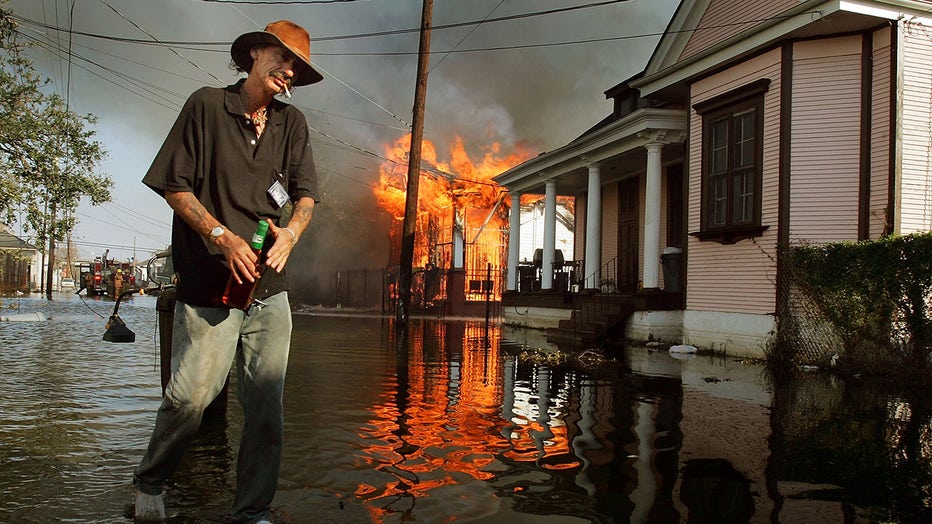
File: A resident walks past a burning house fire in the 7th ward September 6, 2005 in New Orleans, Louisiana. (Photo by Mario Tama/Getty Images)
"This shouldn't be just somewhere that we put a political appointee," Penta said. "This is an important position and needs to be run by someone who knows what they're doing."
Dig deeper:
The law, however, doesn’t always apply to acting administrators like the one currently serving as acting head of FEMA. In his second term, President Donald Trump has had two acting FEMA administrators – Cameron Hamilton and David Richardson – both of whom lack disaster management experience. Hamilton was fired after testifying to Congress that he doesn’t want to see FEMA eliminated, as proposed by Trump.
RELATED: Acting FEMA director replaced after saying he doesn't want to dismantle agency
National Response Framework
The 420-plus-page National Response Plan (NRP), which had been established years prior to Katrina, was refined and deconstructed to a much trimmer National Response Framework (NRF), with input from stakeholders nationwide, Rouse explained.
"This was a remarkable approach and reinforced the notion that the term ‘NATIONAL’ includes the combined levels of governments, all sectors and all entities within the nation, and is not synonymous with ‘federal,’" Rouse said.
‘Whole Community Approach’
The people who weren’t able to evacuate for Katrina were largely poor, elderly and Black. According to the Department of Homeland Security, 71% of the victims who died were older than 60, and 47% of those were over 75. At least 68 victims were found in nursing homes, some of whom were reportedly abandoned by their caretakers. It’s true that in most disasters, people with fewer resources fare worse, but "it was really, really apparent in Katrina," Penta said.
"And so that really spurred this investment in looking at different kinds of vulnerability in disasters, and how we can serve different parts of the community that might have unique needs," Penta explained. "It also sort of was part of this broader movement that led to what's now called the whole community approach that was implemented in a subsequent administration.
"We're really looking at, how do we understand the nuances and dynamics of the whole community, but also involve the community in identifying what those needs are and how to meet those needs, right? Really engaging in those community-based approaches to emergency management and problem solving."
RELATED: How hurricane forecasting has changed since Katrina
FEMA’s uncertain future
What's next:
Trump’s vision for FEMA includes substantial budget cuts and shifting more responsibilities to states, essentially a reversal of the reforms put in place since Katrina.
Trump has been critical of how FEMA operates, saying it "has not worked out well." Department of Homeland Security Secretary Kristi Noem has described FEMA as a "bureaucratic nightmare."
"I refuse to accept that FEMA red tape should stand between an American citizen suffering and the aid they desperately need," Noem told Fox News Digital this week. "That’s why I am working so hard to eliminate FEMA as it exists today, and streamline this bloated organization into a tool that actually benefits Americans in crisis."
Some FEMA employees disagree. This week, at least 180 current and former FEMA employees sent a letter to Congress warning that the Trump administration's efforts to shrink the agency could lead to another disaster similar to Hurricane Katrina.

Hurricane Katrina: Emotional Healing
Twenty years ago, Jeff Gorter and his team arrived in New Orleans to provide psychological first aid and mental health support for those impacted by the storm. Today, he reflects on the emotional toll the devastation took on those helped, and himself
Several of them have since been suspended from their jobs.
Hamilton, the acting FEMA head who was ousted after publicly disagreeing with Trump, spoke out again this week, this time in a post on LinkedIn. He said anyone who claims FEMA is "operating more efficiently, and cutting through red tape is either: uninformed about managing disasters; misled by public officials; or lying to the American public to prop up talking points."
"FEMA is saving money, which is good due to the astronomical U.S. debt from Congress," Hamilton wrote. "Despite this, FEMA staff are responding to entirely new forms of bureaucracy now that is lengthening wait times for claim recipients, and delaying the deployment of time sensitive resources."
According to NPR, staffing shortages caused substantial delays in FEMA’s response to the deadly flash floods that hit central Texas July 4. It reportedly took days for search and rescue teams to get there. Most survivors were unable to reach the federal aid hotline because the Department of Homeland Security let funding lapse, NPR also reported. Some 40,000 calls went unanswered.
The funding lapse was linked to a new Department of Homeland Security policy that requires Noem to personally approve all expenditures of $100,000 or more.
READ MORE: Deadliest floods in recent US history
"Disaster response and recovery is very expensive," Penta said. "It doesn't take very much to exceed $100,000 when we're talking about the amount of personnel and resources. So if you have to get the senior person to sign off on these things, that is of course going to slow things down."
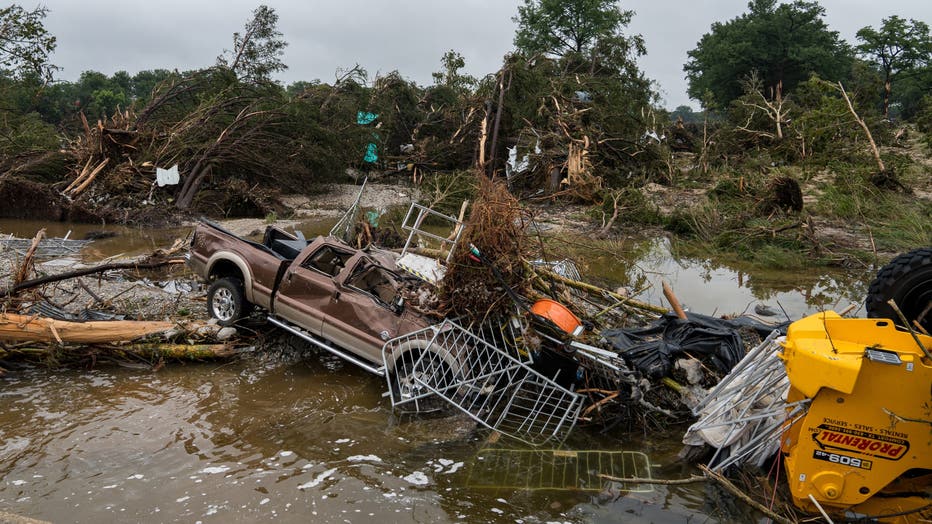
FILE - Flood waters left debris including vehicles and equipment scattered in Louise Hays Park on July 5, 2025 in Kerrville, Texas. (Photo by Eric Vryn/Getty Images)
After deadly tornadoes hit Missouri in May, it took weeks for Trump to approve disaster assistance. Republican Sen. Josh Hawley told St. Louis Public Radio the administration was "slow-walking" everything.
"The need for a lot of support after disasters isn't going away, so just saying that we're not going to support at the federal level isn't going to change the reality … these events are getting bigger and more complex and more severe. It's just going to leave a hole," Penta said.
Rouse, however, countered that a more methodical approach to changes Trump has proposed – like allocating money directly to states and more clearly defining FEMA’s role and resources – could lead to more efficient disaster response.
"We hear different things daily about what precisely is or isn’t happening in terms of FEMA’s mission or funding so it’s hard to know the actual impact," Rouse said. "If states are actually given more dollars (versus having dollars dangled like carrots) to manage their own disaster response, this is an option worth exploring. If FEMA has a refined role of providing certain resources, capabilities, training, or expertise versus being relied upon to deploy a majority of responders, this also seems to be an option worth exploring."
The Source: This report includes information from Samantha Penta, an associate professor for the Emergency Management and Homeland Security Department at the University at Albany, State University of New York; Rebecca Rouse, a professor at Tulane University’s School of Professional Advancement and a former FEMA employee; the Department of Homeland Security; NPR; Fox News Digital, and St. Louis Public Radio.