

Utah wildfire grows rapidly, forcing more evacuations
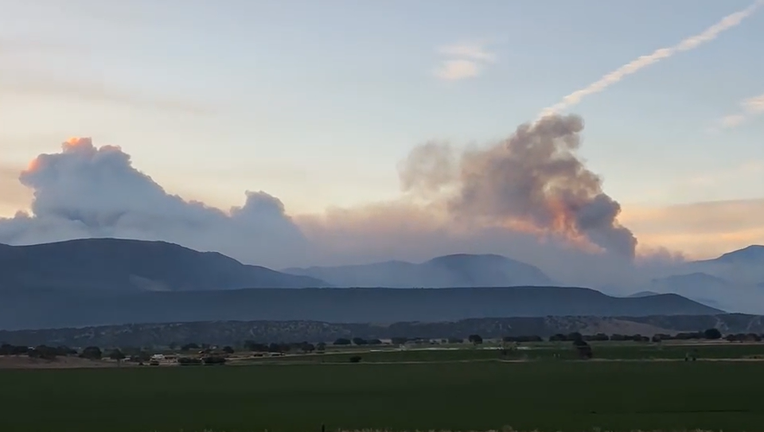
Thick smoke was seen blanketing the horizon near Beaver, Utah, on June 23, as the uncontained Cottonwood Fire surpassed 10,000 acres and prompted widespread evacuations. (Credit: U.S. Forest Service via Storyful)
A fast-moving wildfire swept across Utah overnight, fueled by intense heat and dry winds, forcing additional communities to evacuate, officials said Saturday.
Dig deeper:
Air tankers and helicopters were grounded Friday as winds picked up on the Cottonwood Fire, the largest blaze currently burning in the U.S. Gusts were clocked at 45 miles per hour (72 kph) and humidity levels were in the single digits, leaving crews with few options for slowing the flames, especially as they raced through the treetops.
The U.S. Forest Service said in a statement on Facebook that weather conditions are expected to slightly improve, but not by much.
RELATED: See the photos: Before and after satellite images show aftermath of deadly earthquakes in Venezuela
What they're saying:
"Weather conditions are slightly better for fire behavior today, but extreme fire behavior may occur in the afternoon as temperatures and wind speeds increase," the U.S. Forest Service said Saturday in a statement on Facebook.
No injuries or deaths have been reported, said Jaclynn Swope, a spokesperson for the response team.
The backstory:
The National Weather Service in March said Salt Lake City, Utah's capital, had the warmest winter on record with an average temperature of 40.7 degrees Fahrenheit (4.8 Celsius), nearly 8 degrees above normal. Many other parts of Utah had warmer-than-usual winter.
Burning in a sparsely populated area of southern Utah, the Cottonwood Fire ballooned Saturday to more than 144 square miles (373 square kilometers).
One of several large wildfires burning in Utah, it severely damaged the Eagle Point ski resort in Beaver County and forced campground closures in Fishlake National Forest.
RELATED: How Mount St. Helens eruption transformed volcanic monitoring in WA
Local perspective:
In the community of Marysvale, the smoke blocked out the sun Friday as ash rained down. Officials warned of unhealthy air quality there and elsewhere.
"We’re looking at a full 48 hours of critical weather that we have not seen in Utah in the last five years," meteorologist Jason Straub told a community meeting in Beaver County Friday evening.
Big picture view:
Elsewhere in Utah, evacuations were ordered Friday for several small communities southwest of Salt Lake City, including in Eureka, with a population under 1,000, and the Vernon Reservoir area, officials said. Highways running through the area have been closed.
Two wildfires in that area — the Iron and Cherry fires — ran together overnight, and they are about 38% contained, according to fire officials. The two fires combined are covering about 91 square miles (236 square kilometers).
The smoke pushed mostly east, meaning air quality at popular vacation spots like Zion and Bryce Canyon national parks — located far south of the flames — hasn’t been significantly affected beyond some haze in the Bryce area.
Still, the plume was visible from miles away, even as far as Colorado.
It's like nothing seen in recent memory, Utah state forester Jamie Barnes said earlier this week. She acknowledged that fires are spreading farther and faster "under conditions that defy historical expectations."
Nationally, nearly 3 million acres have burned since the start of the year, pushing the U.S. ahead of the 10-year average.
The Source: The Associated Press contributed to this report. The information in this story comes from statements by the U.S. Forest Service, the National Weather Service, the Utah state forester, wildfire response officials, and local meteorologists. It also includes details from fire incident updates, evacuation orders issued by local authorities, and reporting by The Associated Press based on official briefings and observations from affected communities. This story was reported from Los Angeles.