

Use by, sell by, best by: What’s the difference?

RFK: 8 artificial dyes to be eliminated from food
U.S. Health and Human Services (HHS) Secretary Robert F. Kennedy Jr. said the banning of more than half a dozen synthetic food dyes is just the beginning as he works to confront America’s chronic health crisis.
LOS ANGELES - Confusing food labels have long puzzled shoppers, and now California is standardizing the terms to make it easier to tell the difference between food quality and food safety.
In fact, "use by," "sell by" and "best by" may look similar on food packaging, but they don't all mean the same thing.
Understanding the difference could help consumers save money, reduce food waste and know when a product is actually no longer safe to eat.
Labels defined
Big picture view:
According to the Food Safety and Inspection Service, there are key differences between label phrases that are used.
"Best by" or California’s "best if used by" indicates when a product will be of best flavor or quality. It is not a purchase or safety date.
"Use by" date is the last date recommended for the use of the product while at peak quality. It is not a safety date except when used on infant formula.
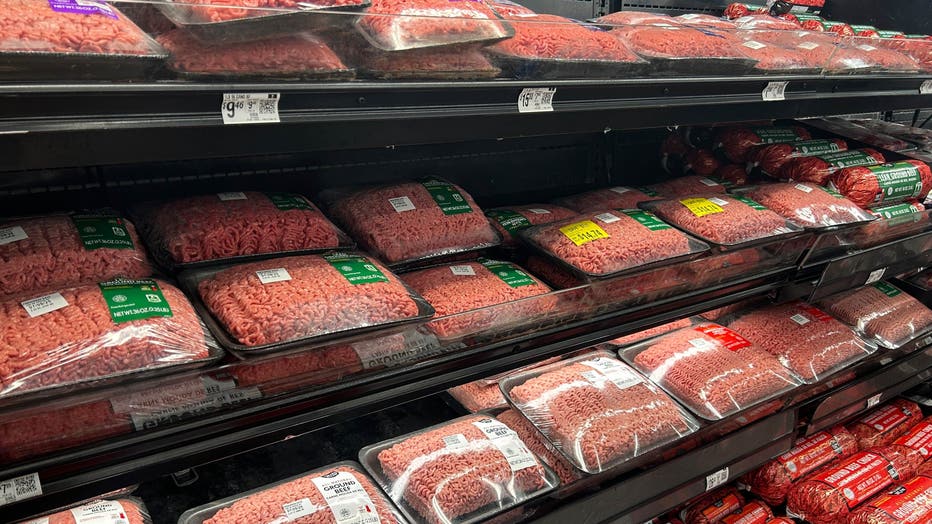
Ground Beef displayed in the refrigerator aisle of grocery store in Denver, North Carolina. (Credit: Lindsey Nicholson/UCG/Universal Images Group via Getty Images)
"Sell by" is a label intended to tell a store how long to display the product for sale for inventory management. It is not a safety date.
"Freeze by" is a date that indicates when a product should be frozen to maintain peak quality. It is not a purchase or safety date.
California bans ‘sell by’ labels
What we know:
According to the Assembly Bill 660, the enacted consumer protection law is designed to stop billions of pounds of unspoiled food from unnecessarily entering California landfills.
Under the legislation, confusing and varied grocery terms are prohibited on consumer-facing packaging.
Instead, the state will mandate a streamlined, uniform terminology system that separates food freshness from health risks.
What we don't know:
The legislative text outlines the structural requirements for manufacturers, but it remains unclear exactly how rigorously local code enforcement and public health agencies will monitor retail shelves.
Why ‘best by,’ ‘sell by’ dates are misleading
A recent study by scientists at Auburn University said that "best by" and "sell by" dates on packaged food contribute to thousands of pounds of food waste each year.
The Auburn study focused largely on meat sell-by dates, which are commonly used by retailers to indicate how long products should remain on store shelves.
The researchers said a change in color doesn't necessarily mean meat is unsafe to eat.
RELATED: Don't dump that steak -- yet: The truth behind "best-by" dates
"Sell by" dates for meat are typically four days after packaging, the news release said.
They're "based on when the beef will start to lose its bright pink color, rather than when it becomes unsafe to eat."
"If a consumer sees that on day three their meat is brown, and it's around the 'sell by' date, they might think it's spoiled, but in fact it's just quality degradation," said Isabella Gafanha, an Auburn master's student who was involved in the research. "It's still fine to eat."
Food labels are largely unregulated
Big picture view:
There are more than 50 different date labels on packaged food sold in stores, according to a 2022 report on food waste published by the University of Maryland. The information on the labels is largely unregulated and often does not relate to food safety.
"Consumers get confused and they just default to assuming that whatever date is on the package means ‘don’t eat it and throw it away’," said Kumar Chandran, policy director at ReFED, a nonprofit focused on reducing food waste.
Currently, the only product that is regulated federally with date labels is infant formula.
Similar legislation proposed in other states
What's next:
California’s new guidelines will be fully implemented by July 1.
Legislation addressing food labeling also has been proposed in Illinois, Maryland, Massachusetts, New Jersey and South Carolina, though it has not passed in those states.
California became the first state in the U.S. to standardize food labels when it approved the law in 2024. New York state lawmakers recently approved a similar law that is awaiting Gov. Kathy Hochul’s signature.
Chandran said California and New York’s approval of food-labeling laws has added momentum to the push for a national standard. A bipartisan bill that would establish uniform food labels is pending in Congress. The U.S. Department of Agriculture recommended a decade ago that food sellers should switch to "Best if Used By" labeling.
What they're saying:
Nick Lapis, director of advocacy at Californians Against Waste, which co-sponsored the bill, said food labels are the leading cause of household food waste.
"We don’t need to build some kind of huge infrastructure and invest tons of money to solve this. We just need companies to use the same words across brands," he said.
The Source: This story was reported from Los Angeles. The Associated Press, FOX 11 LA contributed.