

NOAA finally identifies ‘golden orb’; here’s what it is

Shiny orb found off coast of Alaska stumps scientists
The 'golden egg' is 'biological in origin,' scientists say.
The mysterious "golden orb" that drew widespread attention after being retrieved during a 2023 NOAA expedition has at last been identified.
The news brings closure to a mystery that lingered for more than two years.
NOAA ‘golden orb’ identification
Big picture view:
Researchers with NOAA and the Smithsonian concluded that the "golden orb" was not a complete organism, but rather the remnant base of a deep-sea anemone called Relicanthus daphneae, specifically the portion that had anchored the organism to the seafloor.
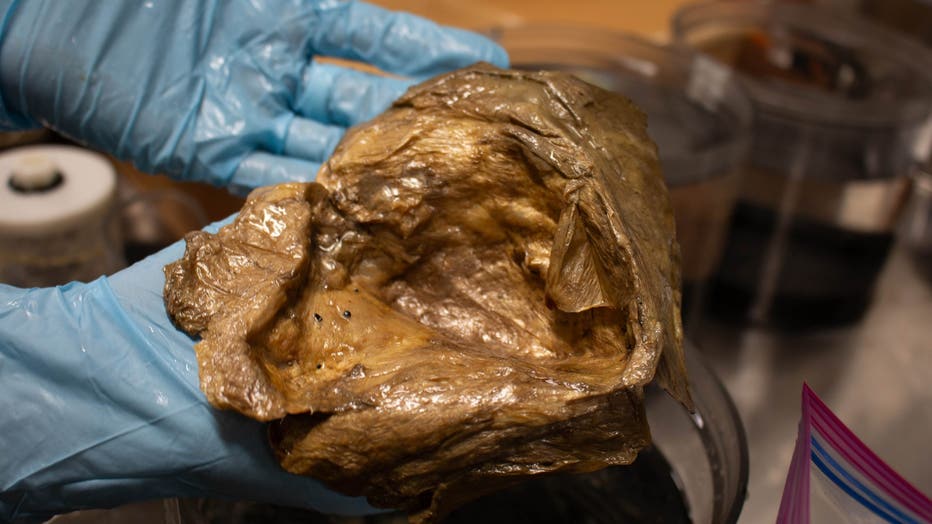
The golden orb specimen, being held by a person with blue rubber gloves, in the lab at the Smithsonian Institute. (Credit: NOAA Fisheries)
Scientists initially struggled because the object lacked recognizable animal features. But closer analysis revealed it was made of fibrous layers packed with stinging cells, pointing to a connection with cnidarians, the group that includes corals and anemones.
What they're saying:
"So often in deep ocean exploration, we find these captivating mysteries, like the ‘golden orb’. With advanced techniques like DNA sequencing, we are able to solve more and more of them," William Mowitt, the acting director of NOAA Ocean Exploration, said in a statement. "This is why we keep exploring – to unlock the secrets of the deep and better understand how the ocean and its resources can drive economic growth, strengthen our national security, and sustain our planet."
‘Golden orb’ discovered in Gulf of Alaska
The backstory:
The "golden orb" was discovered at a depth of 3,250 meters (over 2 miles) in the Gulf of Alaska.
After encountering the strange, golden, mound-shaped object with a hole in it, stuck to a rock, scientists said they were puzzled.
RELATED: Watch: NOAA scientists find mysterious, shiny orb-like object on seafloor
"Was it an egg case? A dead sponge? Had something crawled into it … or out of it?," NOAA asked.
The mysterious discovery attracted a lot of speculation and public interest.
Hoping to find answers, the at-sea team collected the orb using a suction sampler and sent it to the Smithsonian National Museum of Natural History for further examination and study.
"We work on hundreds of different samples, and I suspected that our routine processes would clarify the mystery," Allen Collins, Ph.D, zoologist and director of NOAA Fisheries’ National Systematics Laboratory, explained. "But this turned into a special case that required focused efforts and expertise of several different individuals. This was a complex mystery that required morphological, genetic, deep-sea and bioinformatics expertise to solve."
The Source: The information for this story was provided by NOAA. FOX News, previous FOX Local reporting contributed. This story was reported from Los Angeles.