

Here's how many Americans have a side hustle -- and what they're doing
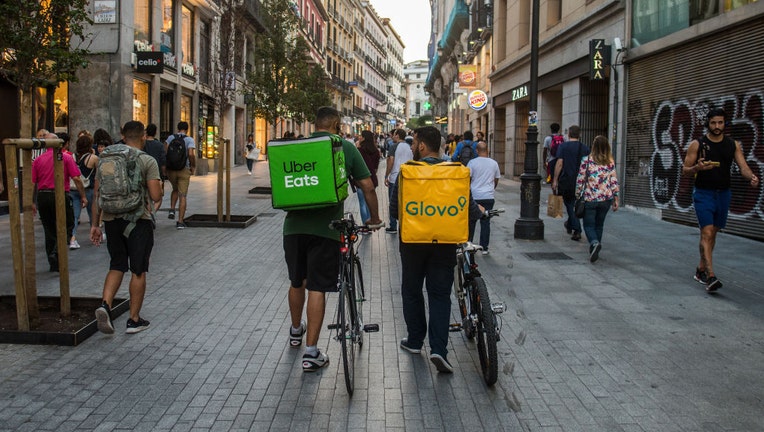
FILE-Couriers for the delivery services Glovo and Uber Eats walk together through a pedestrian street. (Photo by Marcos del Mazo/LightRocket via Getty Images)
Side hustles have become the norm in the U.S. as more people are picking up extra jobs to earn supplementary income.
And while there are an array of reasons for having a side hustle, a new study from Bankrate found that this particular industry is seeing an uptick in activity as more individuals are taking on extra jobs.
RELATED: Here are the top side hustles in 2025
The financial services company conducted an online poll of 2,616 adults between June 2-June 4, 2025 and researchers used data from YouGov Plc. Bankrate also collected a non-probability-based sample and used demographic quotas to correspond with the U.S. population.
Why are people taking on side hustles?
Why you should care:
Forty-one percent of side hustlers overall shared in the poll that they would use the extra money to fund discretionary purchases.
However, respondents in the poll admitted that the side hustle income that they earn is a vital part of their financial security, with 35% saying they use it for regular living expenses, 28% using it for savings, 20% utilize the money to pay down debt and 29% believe they will always need a side hustle to make ends meet.
RELATED: More Americans taking 'side hustles' to make ends meet
But the poll found that some individuals want their side hustle to be their primary job, with 16% of side hustlers saying they want it to be their main source of income.
According to Bankrate, younger generations are most likely to have a side hustle, with Gen Zers (34%) topping the groups with a second job in addition to their full-time job compared to 31% millennials, 23% of Gen Xers and 22% of baby boomers.
The study also noted that 21% of Gen Zers with a side hustle want to turn that gig into their full-time job, compared to 17% of millennials, 112% of Gen X and 11% of baby boomer side hustlers.
What are the most popular side hustles in the U.S.?
Dig deeper:
Americans delving into the side hustle space are gravitating to online sales and professional/business services like freelance writing and consulting, with 15% of side hustlers having online sales gigs compared to 14% working in professional services.
Food delivery and crafts accounted for 9% of side hustlers working in both industries, followed by pet care at 7%, and teaching/tutoring at 6%.
Moreover, the least desirable side hustles for Americans are healthcare 4%, landscaping/home repair (4%), fitness (3%), ridesharing (3%) and home rental at only 2%. Bankrate noted that 43% of Americans with side hustles said they work a second job in an unlisted category.
Side hustle income sees a slight decline
By the numbers:
Bankrate noted that while more Gen Z side hustlers are making less – with 40 percent making between $1 and $50 per month – their average income is still outpacing the amount of money Gen X and baby boomer side hustlers are earning:
- Gen Z side hustlers: $968
- Millennial side hustlers: $1,029
- Gen X side hustlers: $512
- Baby boomer side hustlers: $918
Separately, Bankrate found that median side hustle income earnings are currently at $200 per month, which is down from $250 monthly in 2024.
According to the study, the average side hustler's monthly income is also down from 2024, with side hustlers earning $885 per month in 2025 on average, compared to $891 on average per month last year. Conversely, side hustle income is still up from $810 on average in 2023.
Earnings under $50 per month surpassed other earning groups too, with 8% of side hustlers overall making $1 to $50 monthly on average with their side gig.
The Source: Information for this story was provided by Bankrate, which conducted an online poll of 2,616 adults between June 2-June 4, 2025, and researchers used data from YouGov Plc. Bankrate also collected a non-probability-based sample and used demographic quotas to correspond with the U.S. population. This story was reported from Washington, D.C.