

Alexander Butterfield, Nixon aide who revealed Watergate tapes, dies at 99
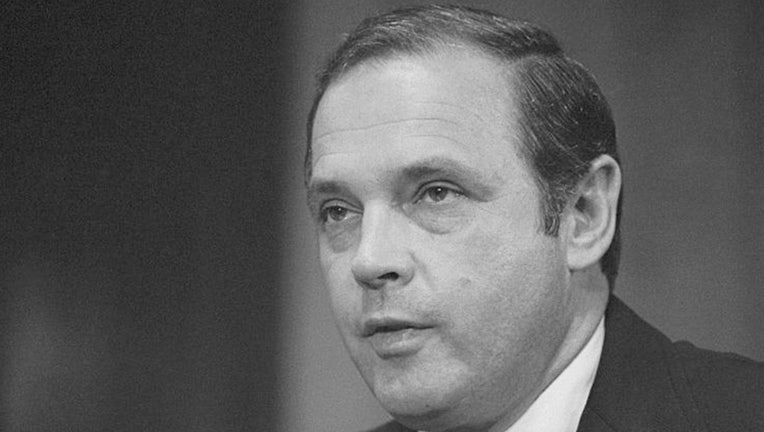
FILE - Alexander P. Butterfield, a former White House Deputy Assistant who now is head of the Federal Aviation Administration, testifies at the Senate Watergate Committee hearing July 16, 1973. ( Bettmann / Contributor/Getty Images)
WASHINGTON - Alexander Butterfield, the White House aide who revealed recorded conversations which would then later expose the Watergate scandal, has died.
He was 99.
What they're saying:
"He had the heavy responsibility of revealing something he was sworn to secrecy on, which is the installation of the Nixon taping system," John Dean, who served as White House counsel to Nixon during the Watergate scandal, told The Associated Press. "He stood up and told the truth."
Butterfield and Watergate
The backstory:
As a deputy assistant to the president, Butterfield oversaw the taping system connected to voice-activated listening devices that had been secretly placed in four locations, including then-President Richard Nixon’s office in the Executive Office Building and the presidential retreat at Camp David.
Butterfield had left the White House to become administrator of the Federal Aviation Administration when he was questioned by Senate committee staffers during their investigation of the Watergate break-in.
A routine question about the possibility of a taping system had been prompted by former White House counsel John Dean’s testimony that he believed a conversation he had had with Nixon may have been recorded.
The tapes would expose Nixon’s role in the cover-up that followed the burglary in 1972 at the Democratic Party headquarters at the Watergate building.
To avoid impeachment by the House, Nixon resigned on Aug. 9, 1974, less than a month after the Supreme Court had ordered him to surrender the relevant tapes to the Watergate special prosecutor.
When Butterfield acknowledged that a taping system indeed existed, he was brought before a public hearing of the Senate Select Committee on Presidential Campaign Activities.
The public revelation on July 16, 1973, of a taping system designed to record all the president’s conversations stunned Nixon’s friends and foes alike.
The tapes promised Watergate investigators a rich vein of evidence in their quest to determine what Nixon and others knew about the break-in, which was a great deal.
Butterfield’s early life
Butterfield was born on April 6, 1926, in Pensacola, Florida.
He left UCLA to join the Navy and later earned a bachelor’s degree from the University of Maryland in 1956 and a master’s degree from George Washington University in 1967.
In 1948, he joined the Air Force and served as an instructor at a base near Las Vegas during the Korean War and later served in Germany.
In Washington, he was a military assistant to the special assistant of the defense secretary in 1965 and 1966 and later served as senior military representative of the U.S. and representative for the commander-in-chief, Pacific Forces, Australia.
He retired at the rank of colonel after 20 years in the Air Force.
The Source: Information about this article was taken from The Associated Press.