

Rising temperatures could keep more flights from taking off on time
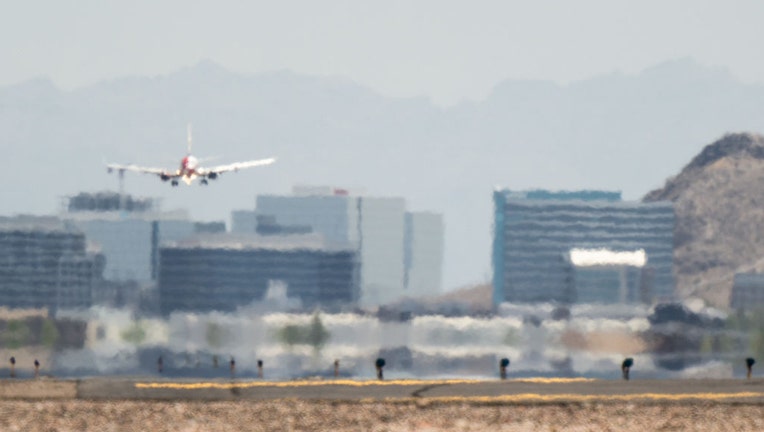
FILE-An airplane approaches the runway at the Phoenix Sky Harbor International Airport during a heat wave on July 15, 2023 in Phoenix, Arizona. (Photo by Brandon Bell/Getty Images)
Air travelers anticipate potential flight delays when weather forecasts thunderstorms and inclement weather, but the predictions are not as obvious on a hot day.
On extremely hot days, thinner air can make it tougher for aircraft to get off the ground safely. Airlines may have to lighten the load by removing passengers or cargo or carrying less fuel.
RELATED: Traveling soon? Here’s what to do if flight is delayed or canceled
Las Vegas displayed how severe heat can disrupt air travel. American Airlines offered restitution to passengers who voluntarily relinquished their seats on a July 24 flight from Harry Reid International Airport after temperatures reached 114 degrees Fahrenheit.
Flight delays due to hot weather may become frequent
Dig deeper:
According to The Associated Press, the Federal Aviation Administration does not set a single maximum temperature for takeoff. Instead, the federal agency said it sets operating limits based on an aircraft's make and model, its weight and the airport’s altitude.
Sweltering temperatures are commonplace in certain desert-like areas, and the type of hot days that might affect flights are becoming more frequent in Phoenix and Las Vegas.
RELATED: Flight delays, cancellations continue as FAA ramps up flight reductions at 40 US airports
According to an analysis of weather station data by The Associated Press. Since 2020, Phoenix Sky Harbor International Airport has averaged 43 days each year when the temperature reached at least 110 F.
The number of these days rose over several decades before skyrocketing in the 2020s to over triple the average during the middle of the last century, according to The Associated Press.
At Harry Reid International Airport in Las Vegas, temperatures reached that peak on an average of roughly 18 days a year between 2020 and 2025 — more than double the annual average during the 1940s through 1960s, the AP noted.
Separately, a 2017 study by researchers from Columbia University, NASA’s Goddard Institute for Space Studies and the Logistics Management Institute, assessed 19 airports around the world and determined that airports with short runways, high elevations and hotter climates were more vulnerable to flight delays.
The other side:
Furthermore, airlines have endured heat-related issues for years. During a period of scorching heat in June 2016, American Airlines canceled several round-trip regional flights between Palm Springs, California, and Phoenix.
In 2017, American canceled dozens of regional flights in Arizona as temperatures in Phoenix climbed to 120 F.
A year later, in July 2018, several airlines moved passengers at Denver International Airport to later flights as temperatures reached 98 F, the AP reported, citing KDVR-TV in Denver.
Delta Air Lines requested volunteers to exit a plane in Las Vegas during an excessive heat warning in July 2023 based on weight restrictions tied to the extreme temperatures.
The Source: Information for this story was provided by The Associated Press, which references a study by researchers from Columbia University, NASA’s Goddard Institute for Space Studies and the Logistics Management Institute and a report from KDVR-TV in Denver. This story was reported from Washington, D.C.