

US Space Force increasing ranks, offers service members from other branches transfer opportunity
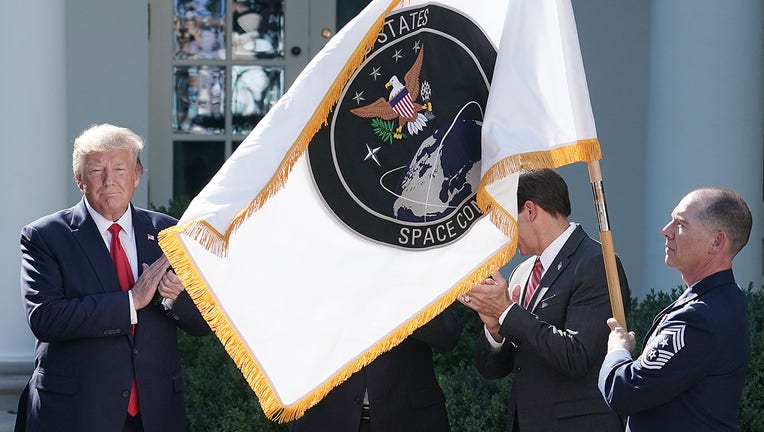
President Donald Trump (L) applauds as the flag for the new U.S. Space Command is revealed in the Rose Garden at the White House August 29, 2019 in Washington, DC. Citing potential threats from China and Russia and the nation’s reliance on satellites
The United States Space Force (USSF) is offering service members from the U.S. Air Force, U.S. Army, U.S. Navy, and U.S. Marine Corps the opportunity to transfer to the USSF through the Interservice Transfer (IST) program.
Dig deeper:
The Fiscal Year 27 USSF IST Space Force application window opened Sept. 15 and runs through Oct. 2, 2026. More information is available on the USSF IST website.
USSF says reserve and National Guard personnel, as well as members of the Coast Guard and Merchant Marines, are not eligible for the IST program.
Guard, Reserve, and prior service members who are interested in seeking active duty entry into the Space Force can contact the 320th Recruiting Squadron directly at 320RCS.A3OS.PriorService@spaceforce.mil for opportunities.
About the U.S. Space Force
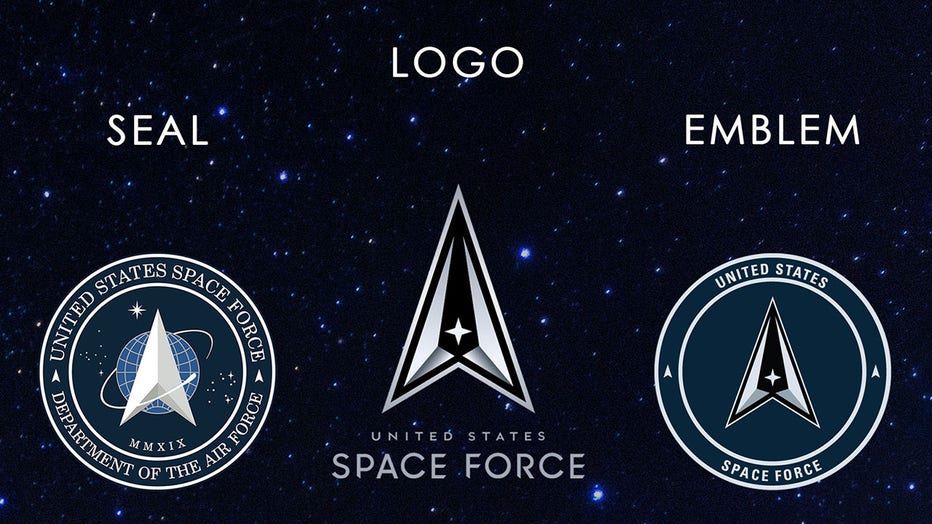
The U.S. Space Force distinctive logo, official seal, and an emblem. (U.S. Space Force)
The backstory:
The USSF was established on Dec. 20, 2019, becoming the first new branch of the armed services since 1947.
USSF organizes, trains and equips personnel in order to protect U.S. and allied interests in space and to provide space capabilities to the joint forces, managing space launch operations at the East and West Coast Space Launch Deltas providing services, facilities and range safety control to conduct DoD, NASA and commercial space launches.
Trump signs executive order to establish the U.S. Space Academy
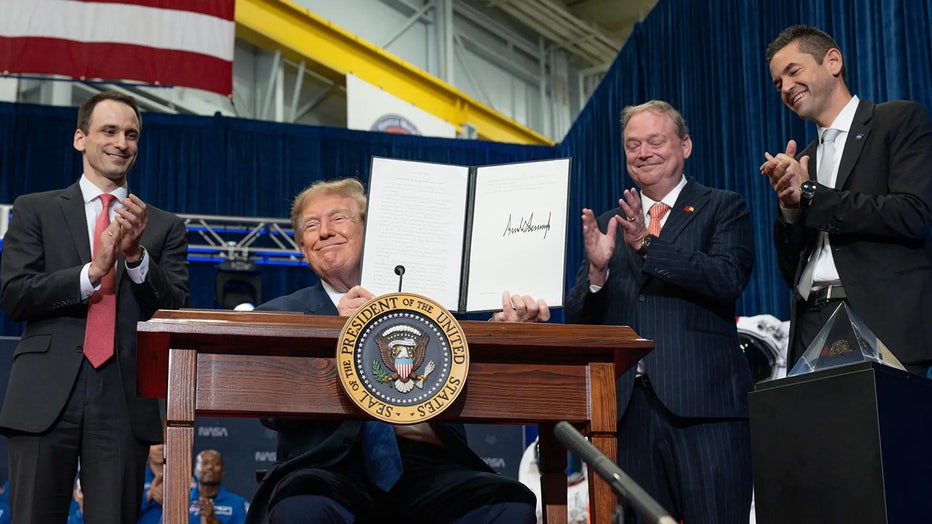
President Donald Trump presents an executive order establishing the United States Space Academy during an event to award the Congressional Space Medal of Honor to the Artemis II crew as Michael Kratsios, director of the Office of Science and Technolo
Last month, President Donald Trump signed an executive order to establish the U.S. Space Academy.
The academy will be for students looking to enter the U.S. Space Force, and also serve NASA and the civilian spaceflight industry.
Trump said the location of the academy was yet to be determined but compared its significance to that of the United States Military Academy in West Point, N.Y., and the United States Coast Guard Academy in New London, Connecticut.
Last week, NASA published a Request for Information, seeking input from states interested in hosting and sponsoring the academy in their state.
Florida, home to the Kennedy Space Center, Houston, home of the Johnson Space Center, and Alabama, home to the Marshall Space Flight Center in Huntsville, are expected to submit bids, which are due by 6 p.m. EDT on Monday, Oct. 26.
RELATED: Governor Abbott creates leadership team to pitch Texas for permanent US Space Academy
RELATED: Lawmakers push for Space Academy in Florida
What they're saying:
"The location of the U.S. Space Academy is foundational to its success," said NASA Administrator Jared Isaacman during the first Presidential Commission on the United States Space Academy meeting on Sept. 9. "We’re asking states to bring their strongest vision — the infrastructure, the partnerships, and the community that can compete with the elite options this caliber of student will have and match the boundless ambition of our future space leaders."
U.S. Space Academy sets a goal to welcome the first class in 2028
An ambitious timeline has been established, with a groundbreaking no later than 2027, with the first 300 students starting in a temporary faculty by 2028, and a permanent location in operation by 2031.
Each state is allowed one submission to the Announcement via its governor’s designee. In addition to details about resources available to support the academy, input sought on the potential campus includes:
- Location information
- Site readiness
- Environmental and regulatory considerations
- Proximity and supporting ecosystems
The Source: This article includes information from the U.S. Space Force, NASA, and previous FOX Local reporting. This story was reported from Orlando.