

National Park tip line backfires as visitors turn on Trump’s history push
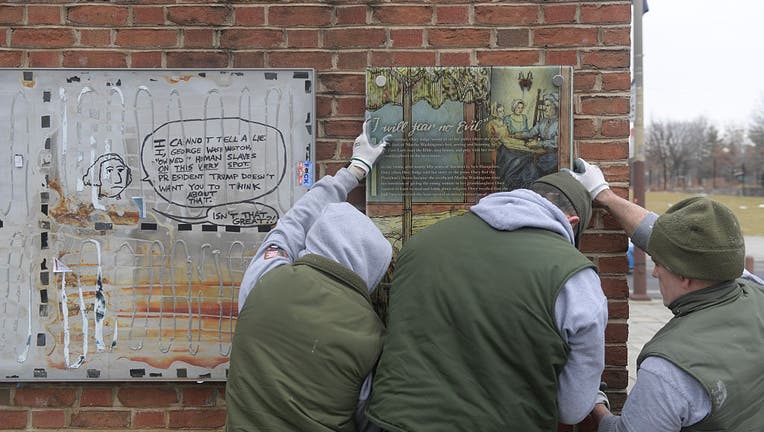
Staff with the National Parks Service replace the plaques that were part of the 'Freedom and Slavery in the Making of a New Nation' exhibit at the President's house on February 19, 2026 in Philadelphia, Pennsylvania. (Photo by Matthew Hatcher/Getty I
BISMARCK, N.D. - Most visitors who responded to the Trump administration’s call to report "negative" portrayals of Americans at national parks instead used the opportunity to criticize the effort itself, according to an Associated Press analysis of 35,000 public comments released through a lawsuit.
Dig deeper:
The Trump administration last year issued a plea to visitors at U.S. national parks: Report any displays or exhibits saying "negative" things about Americans living in the past or present.
But most people who responded instead weighed in to criticize the effort itself, according to an Associated Press analysis of 35,000 public comments submitted in the second half 2025 and recently made public through a lawsuit.
RELATED: Trump administration sued over new signage policy affecting national parks
One visitor to a park in North Carolina called the administration’s efforts "un-American." Another derided the idea of "having Americans call in and snitch on each other."
"Hey Donald Trump!" wrote a person in North Dakota’s Theodore Roosevelt National Park, "Trying to erase history doesn’t mean it didn’t still happen!"
A large chunk — more than half, not even accounting for duplicative submissions — was a backlash to the effort itself, according to an Associated Press analysis.

Texas girl visits 46 U.S. national parks at 25 months old
Journey Castillo is on a mission to explore all 63 U.S. National Parks to encourage kids and families everywhere to enjoy the great outdoors. The 2-year-old has visited 46 parks so far and hopes to complete her mission by the time she turns three. (Video from November 2022)
The backstory:
An order by Interior Secretary Doug Burgum last year targeted "inappropriate content" including any signs and exhibits "negative about either past or living Americans or that fail to emphasize the beauty, grandeur, and abundance of landscapes and other natural features."
The order following one by President Donald Trump on "Restoring Truth and Sanity to American History" sought to emphasize the achievements of America and splendor of its landscape.
RELATED: Here's when you can visit US national parks for free in 2026
The goal, Burgum wrote, was to restore sites to "solemn and uplifting public monuments that remind Americans of our extraordinary heritage, consistent progress toward becoming a more perfect Union, and unmatched record of advancing liberty, prosperity, and human flourishing."
A watchdog group of librarians, public historians and data experts called Save Our Signs, relying on photo submissions and news reports, has documented at least 59 signs removed or modified.
They include signs referring to slavery, climate change, women’s rights and involvement in conservation and Native American history, said Jenny McBurney, a government publications librarian at the University of Minnesota who is part of the group.
Many of the changes were at Philadelphia's Independence National Historical Park, where the administration removed exhibits on the lives of nine people enslaved at the site in the 1790s under George Washington, the first U.S. president. Some of those exhibits were later restored under a judge's order before further work was halted after the administration appealed.

America's most popular national parks
The United States is home to 63 stunning national parks. Here's a look at some of the most visited.
What they're saying:
More than half the comments showed signs of coordination and were critical of the effort itself. But many others were personally crafted.
The comments come to light as a result of a Sierra Club lawsuit seeking their release. Some commended the parks, including their staff and signage.
"We had a great time learning about the development of this site including the difficult parts of our American story," wrote a visitor to Gateway Arch National Park in St. Louis. "We need those reminders to help us become even better in the future."
READ MORE: Judge orders slavery exhibit must be restored at President's House in Philadelphia
Others veered into silliness: "Didn’t see any Bigfeets," wrote a visitor to Washington’s North Cascades National Park.
A large portion, though, took aim at the administration.
"Trump’s idea of having Americans call in and snitch on each other ... is straight out of the fascist playbook he’s literally acting like Hitler or Mussolini," wrote one visitor.
The other side:
Some visitors alerted what they saw as inappropriate references to historical figures, including Black leaders, related to race and inclusion philosophies.
A visitor to Missouri's Harry S. Truman National Historic Site flagged an installation they said praised the former president as a "founding father" of diversity, equity and inclusion and a "precursor" advocate of critical race theory, or a way of looking at U.S. history through the lens of racism.
"I came here to see his hat and maybe a piano, not to read about intersectionality and ‘equity frameworks.’ I nearly choked on my commemorative root beer," the visitor wrote.
RELATED: Lawsuit filed against Trump admin over Stonewall pride flag removal
Another complained that a sign at Virginia's Booker T. Washington National Monument described the Black leader as a "father of DEI and early architect of critical race theory."
"This sign is blatantly misleading, politically loaded, and clearly designed to push a modern agenda by hijacking a respected historical figure. It’s like naming Paul Revere the first Uber driver because he got around fast," the person said.
What's next:
The Trump administration has been vague about the changes it has made as a result of the program.
"In many cases across the system, flagged materials remain unchanged," an Interior spokesperson said in an emailed statement, while not answering questions about signs or exhibits that are or will be changed.
Other locations where signs have been removed or changed include Maine’s Acadia National Park, Wyoming’s Grand Teton National Park, New York City’s Jamaica Bay Wildlife Refuge and Virgin Islands National Park, according to Save Our Signs.
"We hear from folks all over the country that history matters, that our national parks matter and that this is important to them," McBurney said.
The Source: The Associated Press contributed to this report. The story is based primarily on an Associated Press analysis of roughly 35,000 public comments submitted to the National Park Service between June 2025 and January 2026 in response to the Trump administration’s request for visitors to report "negative" portrayals of Americans at national parks. This story was reported from Los Angeles.