

Look up to see the ISS using NASA's 'Spot The Station' app: Here’s how
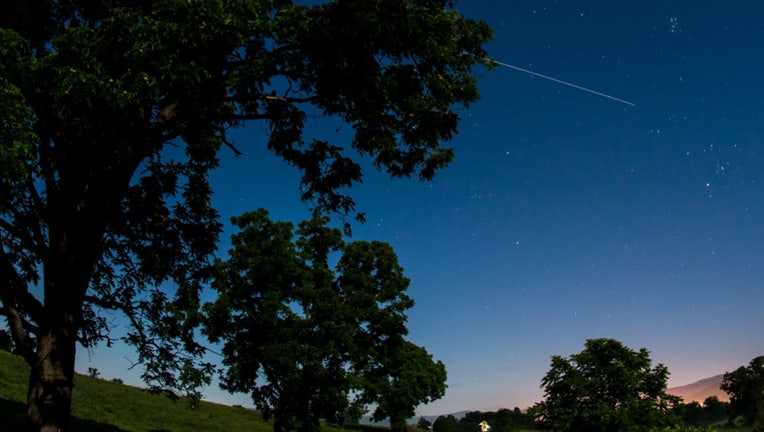
FILE - The International Space Station pictured in this 30-second exposure image over Elkton, Virginia, on Aug. 1, 2015 (Credit: NASA/Bill Ingalls).
Have you ever wanted to see the International Space Station as it orbits the Earth?
Well, you can spot it easily with the help of NASA’s "Spot The Station" app.
Spot the Station
Dig deeper:
The app, which is free to download, allows us Earth-dwellers to look up into the night sky and spot exactly where the ISS is hovering above us.
Here's how it works:
Once you’ve downloaded the app, all you need to do is enter your location.
Once you’ve done that, the app will let you know when the best and next ISS sighting will be happening in your location on the top left corner of your screen.
It’ll also tell you at what time to look up depending on your location.
How to best spot the ISS
What you can do:
The best time to spot the ISS will be within a few hours before or after sunrise/sunset, according to NASA.
"The space station orbits with an inclination of 51.6 degrees. This means that, as it orbits, the farthest north and south of the equator it will go is 51.6 degrees latitude. If a user’s preferred location is north or south of 51.6 degrees, the station will never go directly overhead, this includes places like Alaska," NASA advised.
For those who are in the optimal viewing position, a telescope or other visual aid will not be necessary. The ISS should be visible with the naked eye.
About the ISS
The backstory:
The ISS has been orbiting Earth for more than 25 years, collecting data and conducting experiments in medicine, materials science, and climate research.
By the numbers:
The ISS is about 250 miles away from Earth, orbiting at 17,500 miles per hour.
It’s hosted nearly 300 astronauts from across the world and has traveled more than 4.3 million miles.
The Source: Information for this article was taken from NASA’s International Space Station website and Spot The Station website. This story was reported from San Jose.