

Leonids meteor shower peaks on both Tuesday and Wednesday night - How to best view the celestial show
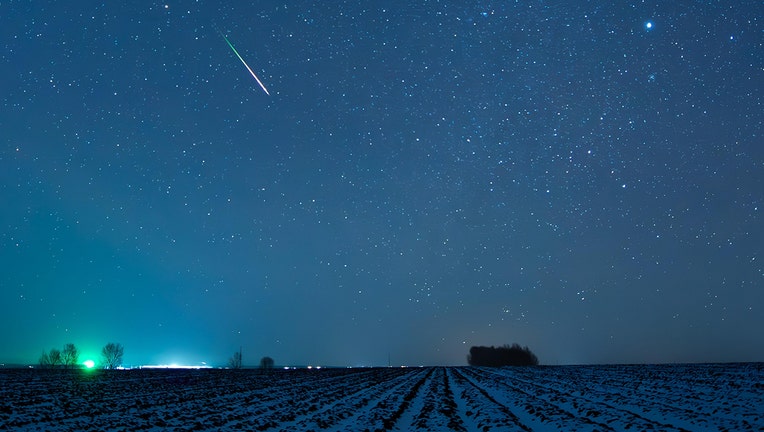
This photo taken on Nov. 18, 2025 shows the Leonid meteor shower seen in Heihe City, northeast China's Heilongjiang Province. (Photo by Qian Boyu/Xinhua via Getty Images)
The Leonid meteor shower will peak this week on both Tuesday and Wednesday night, giving stargazers a great opportunity to see the celestial show.
Timeline:
The best viewing times, according to NASA, are around midnight local time, when the Leonids shower will peak. It's considered to be a major shower, though meteor rates are often as low as about three meteors per hour.
What you can do:
To best view the Leonid meteor shower, NASA says to find an area that is far away from a city or streetlights. Orient yourself to the east, lie flat on your back and look up, taking in as much of the sky as possible. In less than 30 minutes in the dark, your eyes will adapt, and you will begin to see the meteors.
Where do meteors come from?
Dig deeper:
According to NASA, meteors are created when Earth passes through dusty trails of debris left behind by comets and broken asteroids. As those tiny space particles collide with Earth’s atmosphere, they burn up and disintegrate, creating fiery, colorful streaks overhead.
For the Leonids, that cosmic debris comes from Comet 55P/Tempel-Tuttle, which takes 33 years to orbit the sun. Roughly every 33 years, Earth passes through a particularly dense pocket of the comet’s trail, triggering a rare "Leonid storm" capable of producing hundreds to thousands of meteors per hour.
Skywatchers last experienced a Leonid storm in 2002, and it may be a long wait for the next one. While Comet Tempel-Tuttle is set to swing back around in 2031 and 2064, the American Meteor Society notes that Earth isn’t expected to cross another dense debris cloud—meaning no major Leonid storm—until 2099.
The Source: This article includes information from NASA, The American Meteor Society, and FOX Weather. This story was reported from Orlando.