

Judge says agriculture secretary's religious emails calling Jesus 'our Savior' were unconstitutional
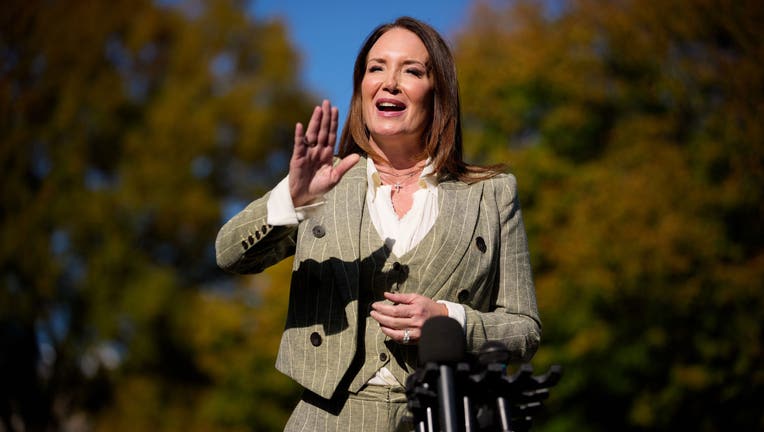
U.S. Secretary of Agriculture Brooke Rollins speaks to reporters on the North Lawn of the White House on November 3, 2026 in Washington, DC. Rollins stopped briefly to speak following an interview outside the West Wing. (Photo by Andrew Harnik/Getty
A federal judge’s ruling on the constitutionality of religious messages U.S. Agriculture Secretary Brooke Rollins sent to approximately 100,000 workers has the agency considering an appeal.
Big picture view:
U.S. District Judge Trina Thompson in San Francisco, responding to a lawsuit brought in May by the National Federation of Federal Employees and six multi-faith and non religious employees, issued a preliminary injunction, ordering Rollins to "recognize certain boundaries when communicating religious messages."
Thompson, whom former President Joe Biden appointed, said Rollins must stop disseminating religious messages when an employee asks her to stop, "cannot create a hostile work environment through persistent unwelcome advances" and "cannot use official authority to pressure subordinates."
She based her ruling on quotes from a USDA policy on workplace religious expression that Rollins adopted.
Emails called into question
Thompson said two of Rollins’ emails violated the First Amendment’s establishment clause. The emails, sent during the 2025 Christmas and 2026 Easter seasons, referred to Jesus Christ as "our Savior" and "our risen Lord."
"And so, like the very first disciples to encounter our risen Lord in the Upper Room almost two thousand years ago, this Easter let us too be alive with hope, full of Paschal joy, and confident in the mission each of us has been called for," Rollins wrote in an April 5 email marking Easter, according to the Associated Press.
Rollins sent messages that included Christian messages and images from her official account on holidays like Independence Day, Thanksgiving, Christmas and Easter.
Rollins did not send messages commemorating holidays from other religions.
Dig deeper:
"The wisdom of the Founders was in recognizing that independence requires freedom of conscience," Thompson ruled. "The command of the Establishment Clause, thus, is to prohibit the government from using its authority to try to sway an individual's decision about whether and how to practice their faith."
The Establishment Clause was designed to prevent the federal government from creating a national church or favoring one religion over another.
Thompson said employees under Rollins cannot realistically opt out of reading emails from their agency’s director. The messages could make them feel coerced to hide their own religious beliefs or feel pressure to adopt Rollins’ faith, the court ruled.
What Rollins can do, per the judge's order
Thompson said Rollins may, however, discuss her religious beliefs with "interested colleagues, share why her faith is meaningful to her, politely invite coworkers to religious services or events," and "express religious viewpoints during appropriate conversations."
Thompson based the ruling on Rollins’ position of authority, the use of an official email account and the messages that suggested Christianity is the shared faith of USDA workers.
What they're saying:
National Federation of Federal Employees President Randy Erwin celebrated Thompson's ruling.
"Federal employees are public servants, not an audience for their bosses' personal religious beliefs," Erwin said in a statement. " NFFE is proud to stand with the workers who brought this challenge and will continue to defend our members' constitutional rights and their ability to serve the American people free from religious coercion."
A USDA spokesperson, meanwhile, called the ruling "a completely unprecedented attempt to muzzle a Cabinet secretary" and said an appeal was being considered.
The Source: Information for this story came from the Associated Press, the U.S. District Court's Northern California Court, and previous FOX News reporting. This story was reported from Orlando.